
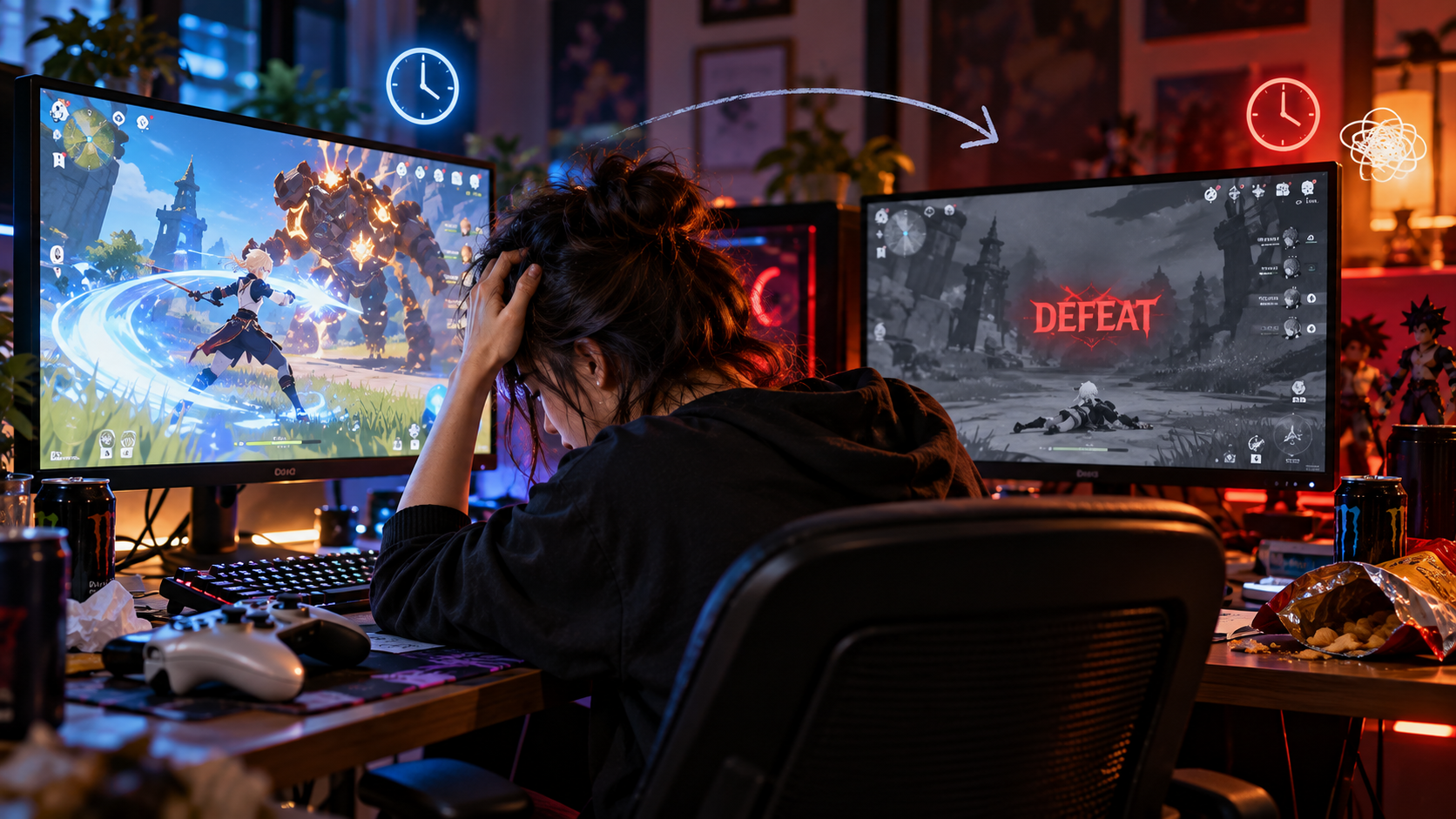
You have been playing for hours.
At the beginning of the session, everything felt sharp.
Your reactions were quick. You noticed enemies early. Combos came naturally. Decisions felt obvious. Even difficult sections seemed manageable.
Then something changes.
You begin missing attacks you normally land.
You walk into obvious danger.
You forget mechanics you were using correctly an hour ago.
In competitive games, your aim becomes inconsistent and your decisions become increasingly reckless. In single-player games, an encounter you should understand suddenly feels frustratingly difficult.
The strange part is that the game itself may not have changed at all.
The enemies have the same health.
Your controller settings are identical.
The difficulty setting has not moved.
Your character has not become weaker.
What changed is the player.
Understanding gaming fatigue explains why a game can feel progressively harder during a long session even when nothing inside the game has actually become more difficult.
Your Performance Is Part of the Difficulty
When players think about difficulty, they usually think about the game.
Enemy damage.
Boss mechanics.
Reaction windows.
Puzzle complexity.
Opponent skill.
Resource scarcity.
But experienced difficulty is produced by two sides interacting.
There is the challenge presented by the game.
Then there is your current ability to respond to that challenge.
If the challenge stays constant while your concentration, reaction quality, patience, or decision-making declines, the experience becomes harder.
The game did not necessarily increase the difficulty.
Your available performance decreased.
This Is Why the Same Encounter Can Feel Completely Different Tomorrow
You spend forty minutes fighting a boss.
Attempt after attempt fails.
Eventually you stop playing.
The next day, you return and defeat the same boss within three attempts.
Players often describe this as suddenly “getting good.”
Sometimes learning certainly happened.
But another factor is simple recovery.
You returned with better concentration.
Your frustration had disappeared.
Your hands were less tense.
Your attention was no longer overloaded by dozens of previous attempts.
The challenge remained.
Your condition changed.
Gaming Requires More Mental Work Than It Appears
From the outside, gaming can look relatively passive.
You sit.
You look at a screen.
You move your fingers.
But many games continuously demand cognitive work.
Players may simultaneously track:
Position.
Movement.
Timing.
Resources.
Cooldowns.
Enemy behavior.
Audio cues.
Objectives.
Teammates.
Map information.
Inventory.
Health.
Possible threats.
The next action.
Individually, each task may seem small.
Together, they create a continuous stream of decisions.
Fast Games Compress Those Decisions
Consider a slow strategy game.
You may have several seconds or minutes to evaluate a situation.
Now consider a competitive shooter.
A player appears.
You identify the target.
Estimate distance.
Move your crosshair.
Control recoil.
Decide whether to commit.
Track ammunition.
Consider nearby enemies.
Adjust position.
All of this can happen within seconds.
The faster the game, the less time the brain has to consciously process each step.
Experienced Players Automate Many Decisions
Beginners consciously think about basic mechanics.
Which button reloads?
Where is the inventory?
How do I dodge?
Experienced players no longer need to think about many of these actions.
They become automatic.
This frees mental capacity for higher-level decisions.
But automatic performance is not completely immune to fatigue.
As concentration declines, even familiar actions can become less precise.
That is when players begin making mistakes that feel strangely basic.
The First Sign May Not Be Feeling Tired
This is important.
You do not always notice gaming fatigue as obvious sleepiness.
Sometimes the first signs appear inside your gameplay.
You begin rushing.
You stop checking corners.
You forget information.
You repeat unsuccessful strategies.
You become irritated by small mistakes.
You press buttons slightly too early.
You lose track of objectives.
You start saying:
“How did I not see that?”
Your performance may detect fatigue before you consciously label yourself as tired.
Reaction Time Is Only One Piece
Gaming discussions often focus heavily on reaction speed.
Reaction matters, particularly in fast competitive games.
But poor performance after a long session is rarely explained by reaction time alone.
Decision quality matters.
Attention matters.
Visual scanning matters.
Prediction matters.
Memory matters.
Patience matters.
Mechanical execution matters.
A player can still react quickly while repeatedly reacting to the wrong thing.
Attention Is a Limited Resource
Games constantly compete for your attention.
An enemy moves on the left.
The minimap changes.
A teammate speaks.
An ability becomes available.
A warning appears.
You hear footsteps.
The objective timer is running.
Strong performance requires deciding what deserves attention at each moment.
After prolonged concentration, maintaining that filtering process can become more difficult.
You Start Missing Things That Were Always Visible
This produces one of the most frustrating gaming experiences.
The enemy was clearly on screen.
The trap was obvious.
The objective marker was visible.
The sound cue played normally.
Yet you somehow missed it.
The information existed.
Your attention simply did not prioritize it in time.
This can feel like the game suddenly became unfair.
But sometimes your information processing has become less efficient.
Tunnel Vision Becomes More Common
As players become tired or frustrated, attention can narrow.
You focus intensely on one target.
Meanwhile, another enemy approaches from the side.
You chase one opponent across the map and forget the objective.
You concentrate on a boss’s health bar and stop noticing the environmental hazard beneath your character.
This is tunnel vision.
The player is still concentrating.
The problem is that concentration has become too narrow.
Good Gaming Awareness Requires Attention Switching
Strong players constantly move attention between different information sources.
Main action.
Minimap.
Resources.
Teammates.
Environment.
Objective.
Threats.
The exact pattern depends on the game.
Fatigue can make these transitions less efficient.
You spend slightly too long looking at one thing.
In a fast game, that small delay can be enough to miss something important.
Mechanical Accuracy Can Decline Gradually
Imagine your normal input is precise within a small timing window.
After several hours, your movements become slightly less consistent.
Not dramatically.
Maybe only a little.
But games often punish small errors.
Aiming slightly too far.
Dodging slightly too early.
Releasing a button slightly too late.
Missing a rhythm input.
Overcorrecting a movement.
One small decline may be difficult to notice.
Repeated across hundreds of inputs, it becomes obvious.
Tension Can Make Precision Worse
Frustration often changes how players physically interact with their equipment.
You grip the controller harder.
Your mouse movements become more aggressive.
Your shoulders tighten.
You lean forward.
Your hands become less relaxed.
You press buttons harder even though pressing harder provides no advantage.
This tension can reduce smoothness.
The more desperately you try to force precision, the less natural your movements may become.
This Creates a Dangerous Feedback Loop
You make a mistake.
You become frustrated.
Frustration creates tension.
Tension makes execution less consistent.
Another mistake happens.
Now you become more frustrated.
The cycle continues.
Eventually you feel as though the game has completely stopped cooperating.
Nothing in the software changed.
Your mental and physical state did.
Competitive Games Make the Effect More Emotional
Losing to AI can be annoying.
Losing repeatedly to another person often feels different.
There is comparison.
Rank.
Pride.
Teammates.
Visible mistakes.
Win streaks.
Loss streaks.
Competitive games can transform ordinary fatigue into emotional decision-making.
This is where players often describe themselves as being “tilted.”
Tilt Changes Decisions
A tilted player does not necessarily forget how the game works.
Instead, they stop applying their knowledge consistently.
They know chasing the enemy is dangerous.
They chase anyway.
They know they should wait for teammates.
They push alone.
They know the next match should probably be their last.
They queue again immediately.
Knowledge remains.
Decision discipline disappears.
Losing Can Make Players Play Faster
After a frustrating loss, players often want to recover immediately.
They rush into another match.
Then they rush decisions inside that match.
There is an unconscious desire to make something happen.
Slow, disciplined play begins to feel unbearable.
This is especially dangerous in games where patience creates advantages.
Trying harder becomes playing worse.
Winning Can Also Encourage Bad Decisions
Fatigue is not only a problem during losing streaks.
Winning can create overconfidence.
You have won four matches.
Everything feels easy.
You start taking unnecessary risks.
You stop respecting opponents.
You continue playing longer than planned because the session feels successful.
Then performance drops.
A winning streak can turn into a losing streak simply because the player continued beyond their best performance window.
“One More Game” Is Not Always One More Game
Multiplayer games are particularly good at creating continuation loops.
A match ends.
The next queue is one click away.
Maybe the previous match was terrible and you want redemption.
Maybe it was excellent and you want to continue the streak.
Either way, stopping feels less attractive than starting another game.
Suddenly another hour has passed.
The transition between matches is therefore an important moment.
Use Match Boundaries as Checkpoints
Instead of automatically pressing queue again, use the end of a match as a quick performance check.
Ask yourself:
Am I still making deliberate decisions?
Am I getting unusually irritated?
Am I repeating obvious mistakes?
Is my posture uncomfortable?
Am I actually enjoying this session?
Do I want another match, or do I simply dislike stopping after that result?
You do not need a complicated routine.
A few seconds of awareness can interrupt automatic re-queuing.
Single-Player Games Create a Different Form of Fatigue
There may be no ranking system.
No teammates.
No competitive pressure.
Yet long single-player sessions can still degrade performance.
Open-world games require navigation and planning.
Action games demand timing.
RPGs involve inventory, builds, quests, and dialogue.
Strategy games require continuous decision-making.
Puzzle games demand sustained reasoning.
The mental workload simply appears in different forms.
Puzzle Fatigue Is Especially Easy to Misinterpret
You stare at a puzzle.
Nothing makes sense.
You try increasingly complicated solutions.
Eventually you conclude that the puzzle is poorly designed.
After a break, you return.
The answer suddenly looks obvious.
Why?
Long periods of unsuccessful thinking can trap players inside the same assumptions.
A break interrupts the loop.
You return with a different perspective.
Repetition Can Reduce Observation
Boss fights demonstrate this clearly.
On early attempts, you carefully watch animations.
After twenty failures, you may stop observing and start predicting.
You assume:
“The next attack is the sweep.”
Then the boss uses something else.
You react late because you were responding to expectation rather than information.
Experience normally improves prediction.
Fatigue can turn prediction into autopilot.
Autopilot Is Useful Until the Situation Changes
Games depend heavily on pattern recognition.
You learn common enemy behavior.
Routes.
Combos.
Timing.
Map layouts.
These patterns reduce cognitive effort.
But when you become too automatic, unusual situations are easier to miss.
You execute the familiar response even though the current situation requires something different.
This is one reason tired players sometimes make mistakes that look inexplicable in recordings.
Decision Quality Often Falls Before Mechanical Skill
A player may still aim reasonably well but begin taking terrible fights.
A strategy player may still understand every unit but make poor economic choices.
A racing player may still control the car but attempt reckless overtakes.
A survival player may know the map perfectly but enter dangerous areas without preparation.
Mechanics are only one component of gaming performance.
Decision quality can deteriorate independently.
Working Memory Matters
Many games require players to temporarily hold information.
An enemy used an ability recently.
A teammate said someone was approaching.
You saw an item in another room.
A boss has completed two attacks in a sequence.
You planned to return to a particular location.
This information may only need to remain available for seconds or minutes.
But losing track of it can change the outcome.
Fatigue Makes Small Pieces of Information Easier to Lose
You open the inventory and forget what you intended to craft.
You rotate across the map and forget why you went there.
You remember an enemy was low on health but forget that their teammate was nearby.
You begin a combo and skip part of the sequence.
Again, the game has not changed.
Your ability to maintain relevant information has become less reliable.
Audio Processing Can Decline Too
Many games use sound as information.
Footsteps.
Reloading.
Ability activation.
Enemy direction.
Vehicle movement.
Environmental warnings.
Players may technically hear these sounds without meaningfully processing them.
After hours of stimulation, important audio can blend into the background.
You later realize:
“I heard the footsteps. Why didn’t I react?”
Hearing and acting on information are not the same thing.
Volume Does Not Solve Attention Fatigue
Turning the game louder will not necessarily restore awareness.
In fact, excessively loud audio can create additional discomfort.
The issue may not be whether the signal reaches your ears.
The issue may be whether your attention identifies the signal as important.
Better concentration cannot always be created by increasing sensory intensity.
Visual Clutter Becomes Harder to Process
Modern games can display enormous amounts of information.
Damage numbers.
Particle effects.
Ability indicators.
Status effects.
HUD elements.
Objective markers.
Character outlines.
Notifications.
During fresh play, experienced players filter this efficiently.
When tired, distinguishing useful information from visual noise may require more effort.
This Is Why Simple Mistakes Cluster Together
One mistake happens.
Then another.
Then three more within five minutes.
It can feel like your skill suddenly disappeared.
But declining attention affects multiple systems simultaneously.
Aim becomes slightly worse.
Awareness drops.
Patience falls.
Memory becomes less reliable.
Together, these small declines create a noticeable performance collapse.
Not Every Bad Match Is Fatigue
This distinction matters.
Sometimes the opponent is simply better.
Sometimes matchmaking produces a difficult lobby.
Sometimes the game introduces a challenging section.
Sometimes your strategy is wrong.
Sometimes network conditions interfere.
Sometimes you are learning unfamiliar mechanics.
Gaming fatigue is one possible explanation, not a universal excuse.
The useful skill is recognizing patterns across your own sessions.
Compare Yourself to Yourself
Instead of asking:
“Am I playing badly?”
Ask:
“Am I playing differently from how I was playing earlier?”
Are you checking the minimap less often?
Missing inputs that were consistent earlier?
Making faster decisions with less thought?
Repeating the same mistake?
Becoming more irritated?
These comparisons are more informative than simply looking at wins and losses.
Rank Can Hide Performance Decline
You can win while playing poorly.
Perhaps your teammates carry the match.
Perhaps the opponent makes larger mistakes.
Perhaps you get lucky in a critical moment.
Similarly, you can lose while playing well.
Therefore, win-loss results are imperfect indicators of fatigue.
Evaluate the quality of your decisions, not only the final screen.
A Break Does Not Need to Be Long
Players sometimes imagine that taking a break means ending the entire gaming session.
Not necessarily.
Even stepping away briefly can interrupt repetitive patterns.
Stand up.
Look away from the screen.
Get water.
Move around.
Allow your hands to relax.
Return after the continuous stream of game information has stopped for a moment.
The point is not following a magical timer.
It is creating separation.
Physical Comfort Influences Mental Performance
An uncomfortable player is using attention on discomfort.
Chair position.
Desk height.
Controller grip.
Mouse posture.
Screen distance.
Room temperature.
Lighting.
None of these will transform an inexperienced player into an expert.
But unnecessary discomfort can make sustained concentration harder.
Eye Strain Can Make the Game Feel More Demanding
Long periods of staring at a screen can produce visual discomfort for some players.
Small text becomes less pleasant to read.
Tracking movement becomes tiring.
Bright effects become irritating.
Players may start squinting or leaning closer.
At that point, continuing to demand maximum visual attention from yourself may not produce better play.
Hydration and Meals Are Easy to Forget During Immersive Sessions
A good game removes awareness of time.
That is part of the appeal.
But it also means ordinary routines can be postponed.
Players sometimes realize several hours later that they have barely moved from the desk.
Gaming performance exists inside ordinary human conditions.
Ignoring basic needs does not create additional focus indefinitely.
Caffeine Cannot Replace Recovery
Players often reach for coffee or energy drinks when concentration declines.
Caffeine may affect alertness, but feeling more awake does not necessarily restore every aspect of performance.
A player can feel energized while still making poor decisions.
It can also make it easier to extend a session far beyond the point where playing remains enjoyable.
More stimulation is not always the same as better performance.
Sleep Has an Obvious but Frequently Ignored Role
Late-night gaming creates a familiar situation.
The player knows they are tired.
But the next checkpoint is close.
Or the group wants another match.
Or the new area is interesting.
Eventually, basic actions become harder.
The player interprets every failure as a problem requiring more attempts.
Sometimes the most effective solution is simply continuing another day.
Practice Quality Matters More Than Endless Repetition
Players who want to improve often assume more hours automatically produce more skill.
Practice matters.
But low-quality repetition can reinforce poor habits.
If you repeatedly execute mechanics while frustrated and careless, you are not necessarily practicing the version of the behavior you want to retain.
Focused practice and exhausted repetition are not equivalent.
Stop Practicing When Technique Collapses
Imagine practicing a difficult combo.
At first you execute it correctly seven times out of ten.
An hour later, you succeed twice out of ten.
Your inputs become frantic.
You begin guessing.
Continuing for another hour may not be productive.
A better option can be stopping and returning when you can practice deliberately again.
Improvement Happens Between Sessions Too
Learning does not only happen during active play.
You play.
You encounter patterns.
You make mistakes.
You stop.
Later, you return and some actions feel more natural.
This is why players sometimes experience sudden improvement after time away from a game.
Not every minute of progress needs to happen while the game is running.
Difficult Games Can Benefit From Intentional Stopping Points
Games built around repeated failure can make stopping psychologically difficult.
You were close.
The boss had five percent health.
Surely the next attempt will work.
Sometimes it does.
Other times, the near-win keeps you playing through another hour of increasingly poor attempts.
Setting a stopping condition beforehand can help.
For example:
Three more attempts.
Finish this checkpoint.
End after this match.
Stop when execution becomes noticeably inconsistent.
The exact rule is less important than making the decision before frustration takes control.
Recordings Can Reveal Fatigue Better Than Memory
If you record gameplay, compare an early match with a late one.
You may notice changes that were invisible while playing.
Crosshair placement becomes less disciplined.
Movement becomes more impatient.
You check information less frequently.
Positioning becomes aggressive without reason.
You repeat predictable actions.
Video removes some of the emotion from the moment.
Patterns become easier to see.
Competitive Players Can Track Session Quality
You do not need sophisticated analytics.
A simple personal note can be enough.
When did you start?
How long did you play?
When did concentration begin declining?
Were later matches still productive?
Over time, you may discover your own pattern.
Perhaps your best play consistently occurs during the first ninety minutes.
Perhaps you perform well after a short break.
Perhaps late-night sessions are consistently poor.
The useful pattern is personal.
Longer Sessions Are Not Automatically Bad
There is no universal session length after which everyone suddenly becomes terrible.
Games differ.
Players differ.
Activities differ.
A relaxed building game is not mentally identical to ranked competition.
A story-driven RPG is different from high-level rhythm gameplay.
The point is not that long gaming sessions are inherently wrong.
The point is that performance should not be assumed to remain constant throughout them.
Different Games Produce Different Types of Fatigue
A competitive shooter may demand constant visual scanning and rapid decisions.
A strategy game may require planning and working memory.
A fighting game emphasizes timing, prediction, matchup knowledge, and precise execution.
A racing game demands sustained attention and consistency.
A survival game may require navigation, resource planning, and risk assessment.
The feeling of fatigue can therefore look different depending on the game.
Switching Games Can Feel Refreshing
After struggling in one game for hours, players sometimes switch to another and suddenly feel fine.
This can seem contradictory.
Weren’t they tired?
Possibly.
But the second game may demand different cognitive skills.
It may also remove the frustration associated with the first game.
Changing activities can make the mind feel temporarily refreshed because the workload changes.
That does not necessarily mean fatigue disappeared completely.
Difficulty Settings Can Hide the Real Problem
In single-player games, a tired player may consider lowering the difficulty because an encounter suddenly feels impossible.
There is nothing wrong with adjusting difficulty if that creates a better experience.
But before assuming the game’s challenge has become unreasonable, consider whether your session quality has changed.
You may discover that the same section feels completely manageable after returning later.
Your Brain Starts Predicting Failure
Repeated failure creates expectations.
You enter the boss arena thinking:
“This attack always kills me.”
Your attention becomes centered on avoiding that specific failure.
Then you make a different mistake.
Expectation changes behavior.
After enough failed attempts, you may stop responding naturally and begin playing around the memory of previous failures.
Frustration Makes Experimentation Harder
Early in a challenge, players try different ideas.
Maybe this weapon works.
Maybe there is another route.
Maybe the timing is different.
After repeated failure, experimentation often decreases.
The player becomes obsessed with forcing one approach to work.
This is ironic because the moment they most need flexibility is when frustration makes them least willing to change.
A Break Can Restore Curiosity
Returning later creates psychological distance.
Instead of immediately repeating the previous strategy, you may notice something new.
A path you ignored.
A pattern in the enemy animation.
A resource you forgot.
A mechanic you misunderstood.
Rest does not magically reveal solutions.
But it can reduce the fixation that prevents you from seeing alternatives.
Team Communication Also Deteriorates With Fatigue
Multiplayer performance is not only individual mechanics.
Players communicate.
Call positions.
Share resources.
Coordinate pushes.
Warn teammates.
As frustration rises, communication can become shorter, less informative, or more emotional.
Useful information is replaced by complaints.
The team loses another layer of performance.
Blame Consumes Attention
A teammate makes a mistake.
You spend the next thirty seconds thinking about it.
Meanwhile, the match continues.
Even if your criticism is justified, your attention is now directed toward an event that has already happened.
Competitive games punish attention spent on the past.
The more frustrated the player becomes, the harder it is to return attention to the current state.
The Next Decision Matters More Than the Previous Mistake
This is one of the most useful gaming habits.
You cannot undo the missed shot.
You cannot recover the item already lost.
You cannot change the teammate’s previous decision.
You can influence what happens next.
Players who recover attention quickly often perform better than players who rarely make mistakes but mentally remain attached to them.
Mistakes are unavoidable.
Recovery is a skill.
Recognize Your Personal Warning Signs
Different players show fatigue differently.
One becomes impatient.
Another becomes silent.
Someone else begins constantly changing settings.
Another repeatedly blames matchmaking.
Some players start playing too aggressively.
Others become overly cautious.
Learning your own warning signs makes it easier to recognize when the session has changed.
Constantly Changing Settings Can Make Things Worse
Your aim feels bad.
You increase sensitivity.
Two matches later it still feels bad.
You change it again.
Then you adjust field of view.
Then keybinds.
Then graphics.
Sometimes a technical adjustment is genuinely needed.
But changing settings because of temporary poor performance can destroy the consistency you are trying to recover.
Do Not Diagnose Every Bad Session as a Hardware Problem
A new mouse will not automatically fix poor positioning.
A faster monitor will not fix frustration.
A different controller will not restore concentration.
Hardware matters within appropriate contexts.
But equipment is easy to blame because it offers a concrete explanation.
Player condition is less visible.
Before buying or changing something, identify whether the problem is actually persistent.
Technical Problems Still Exist
On the other hand, do not assume every strange feeling is fatigue.
Check genuine technical issues when appropriate.
Network instability.
Frame-time spikes.
Controller drift.
Thermal throttling.
Background processes.
Display settings.
Input problems.
A useful diagnosis separates technical inconsistency from player inconsistency.
If the game behaves differently even when you are fresh, investigate the system.
Gaming Fatigue and Poor Frame Pacing Feel Different
A performance issue can produce visible or measurable stuttering.
Input may feel inconsistent because frames are delivered unevenly.
Gaming fatigue instead tends to appear through the player’s behavior.
Missed information.
Poor choices.
Reduced patience.
Mechanical inconsistency.
The two can coexist, but they require different solutions.
Do Not Use FPS Alone to Judge Your Own Performance
A counter showing 144 FPS tells you how the game is rendering.
It does not tell you whether you are mentally processing the match effectively.
Technical performance and human performance are separate layers.
Both affect the experience.
Understanding which layer is failing prevents unnecessary troubleshooting.
Create a Better Gaming Session Instead of Forcing a Longer One
If improvement matters to you, structure can help.
Start when reasonably alert.
Warm up if the game benefits from it.
Play focused matches.
Notice when decision quality changes.
Take breaks when needed.
Stop if frustration is replacing deliberate play.
Review mistakes when useful.
Return later.
This is less dramatic than grinding endlessly, but often more productive.
Casual Players Benefit From This Too
You do not need to be an esports competitor.
Gaming is entertainment.
If the session has shifted from enjoyable challenge to repetitive frustration, recognizing fatigue can protect the experience itself.
Sometimes the correct response to:
“This game suddenly feels terrible”
is not uninstalling it.
It is closing it for tonight.
The Goal Is Not Maximum Performance Every Minute
Nobody maintains peak concentration indefinitely.
Even excellent players make mistakes.
Some sessions will simply be bad.
The useful idea is understanding that your ability is dynamic.
Your skill level may be relatively stable.
Your access to that skill changes from moment to moment.
That distinction explains many apparently mysterious gaming experiences.
Skill and Performance Are Not the Same Thing
Skill is what you have learned.
Performance is how effectively you can express that skill right now.
A skilled player can perform poorly.
A beginner can occasionally perform above their normal level.
Fatigue primarily affects performance.
That is why one terrible night does not mean you suddenly became a worse player.
And one incredible match does not mean every future match will look the same.
Stop Asking Only, “Why Is the Game So Hard?”
A more useful question may be:
“What changed since I was playing well?”
Maybe the enemies became stronger.
Maybe you entered a harder area.
Maybe matchmaking improved.
But perhaps you have also been playing for four hours.
Perhaps your decisions are faster and worse.
Perhaps your hands are tense.
Perhaps you are replaying the previous loss in your head.
Looking at both the game and the player produces a better diagnosis.
Conclusion
Games do not need to secretly increase their difficulty for them to feel harder as a session continues.
The challenge can remain exactly the same while the player’s ability to respond changes.
That is the core of gaming fatigue.
Attention becomes less consistent.
Small pieces of information are easier to miss.
Mechanical execution can become less precise.
Working memory carries less information reliably.
Patience declines.
Frustration increases.
Players begin repeating decisions they would normally recognize as mistakes.
Because these changes happen gradually, the easiest explanation is often:
“The game suddenly got harder.”
But sometimes the game is exactly where it was two hours ago.
You are simply no longer playing under the same conditions.
Recognizing that difference can save you from endlessly changing settings, blaming hardware, forcing another twenty attempts, or turning one frustrating match into an entire losing session.
Sometimes improvement means practicing more.
Sometimes it means analyzing your mistakes.
And sometimes the smartest gaming decision you can make is surprisingly simple:
Stop playing for a while, then come back when you can actually play like yourself again.