
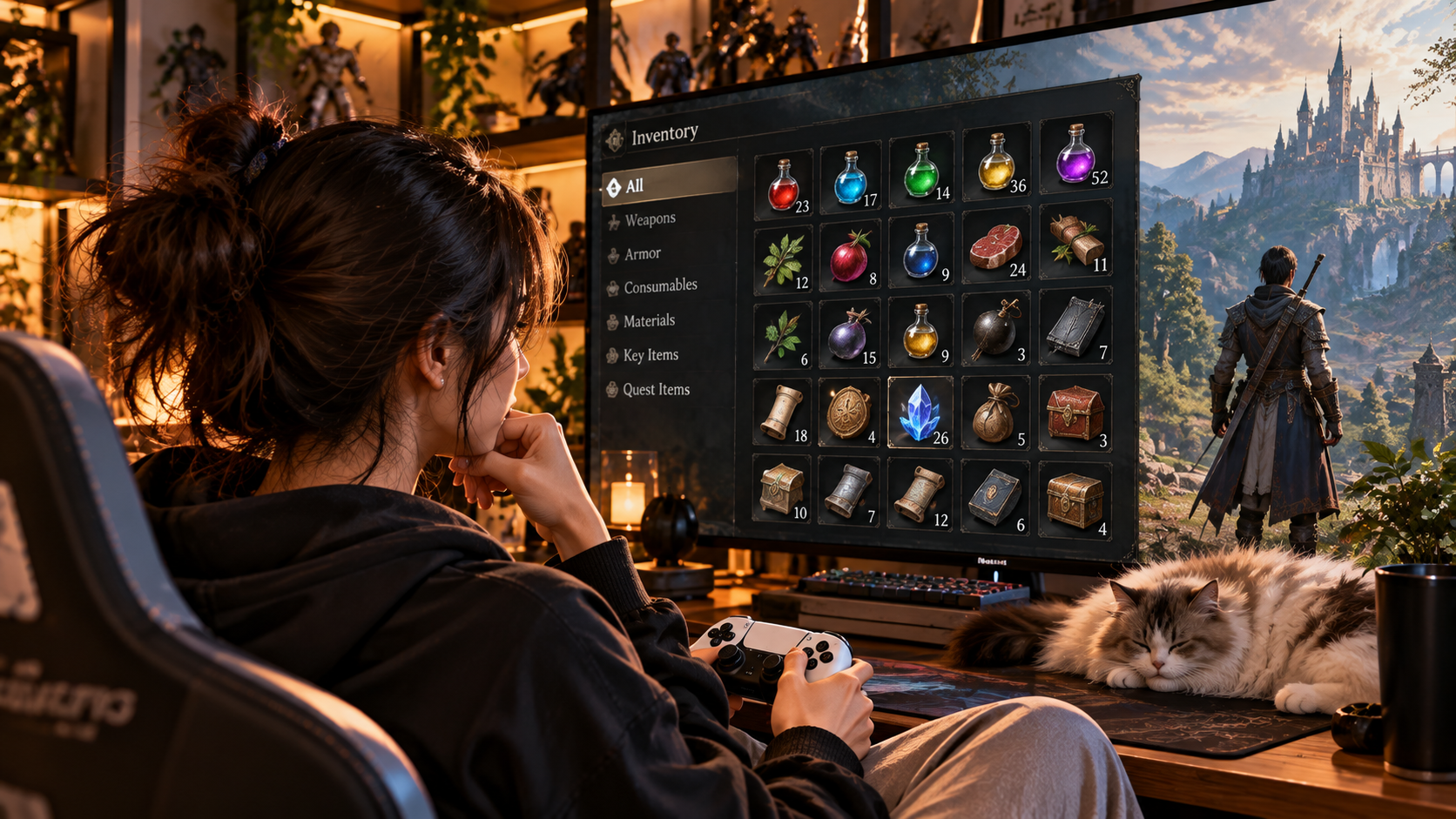
The boss fight is going badly.
Your health is low. Healing potions are sitting in your inventory. You have a powerful temporary buff, several rare explosives, and an item specifically designed to help during difficult encounters.
Using them would make perfect sense.
Instead, you think:
“I might need these later.”
So you try the fight again without them.
Maybe you die three more times.
Eventually, you win through practice, stubbornness, or slightly better execution—and all those valuable items remain untouched.
Then the same thing happens at the next boss.
And the next one.
Eventually the credits roll while your inventory still contains items you spent the entire game protecting from the one thing they were designed for: being used.
This behavior is often described as consumable hoarding, and it appears across RPGs, survival games, action games, strategy games, roguelikes, and many other genres.
It can look irrational from the outside. If an item makes the current challenge easier, why refuse to use it?
But from the player’s perspective, saving it often feels completely logical.
The real problem is uncertainty.
You know how difficult the current fight is.
You have no idea what the game will ask from you two hours later.
The Item Feels More Valuable Before You Use It
Permanent upgrades are easy to understand.
Upgrade your sword and the sword remains stronger.
Unlock a skill and you can probably use it repeatedly.
Equip better armor and its benefit continues into future encounters.
Consumables work differently.
Use a potion and it disappears.
Throw the rare grenade and your inventory count drops from three to two.
Activate the special buff and you may never get that exact resource back.
That creates an immediate psychological cost.
Before using the item, you possess both the item and the possibility of using it later.
After using it, that future option disappears.
So even when using the item is strategically reasonable, saving it can feel safer.
“I Might Need It Later” Is Hard to Argue Against
Imagine finding a powerful item early in an RPG.
Its description says it dramatically increases damage for a short period.
That sounds useful.
But useful when?
Against the enemy standing in front of you?
The dungeon boss?
The next major boss?
The final boss?
A secret superboss you do not even know exists yet?
Without knowing what is coming, there is no obvious answer.
Saving the item preserves flexibility.
Using it commits the resource to a problem you already understand.
This is why consumable hoarding can continue even when the player has accumulated far more resources than they realistically need.
Every individual item still represents insurance against an unknown future.
Rare Items Create Their Own Problem
The more unusual an item looks, the harder it can become to use.
A normal healing potion might be easy to spend because shops sell more.
But what about an elixir that completely restores health and mana?
Or a grenade you have only found twice in twenty hours?
Or a scroll that instantly revives the entire party?
Its rarity sends a message:
“This is important.”
Unfortunately, players can interpret that message as:
“Do not waste this.”
The item becomes so special that no ordinary encounter feels worthy of it.
Then the boss appears.
But what if there is a harder boss afterward?
The resource survives again.
Players Rarely Know Whether an Item Is Truly Renewable
One of the biggest factors is replacement.
Suppose you have five powerful bombs.
Can you craft more?
Will shops eventually sell them?
Do enemies drop the ingredients?
Does the item become common later?
Or are those five bombs all you will ever receive?
If the game does not communicate this clearly, conservative play becomes understandable.
Players may treat a renewable item as extremely rare simply because they do not yet understand its economy.
Once they know an item can be reliably replaced, using it becomes psychologically easier.
Scarcity Changes How We Play
Resource scarcity can create excellent gameplay.
Survival horror would feel very different if ammunition were unlimited.
A tactical RPG loses some decision-making if every powerful consumable can be spammed without consequence.
Scarcity creates tension.
Do you heal now?
Use the grenade?
Spend the expensive crafting material?
Save ammunition by using a weaker weapon?
Those decisions can make resources meaningful.
But scarcity also creates a paradox.
Make an item too easy to obtain and players stop caring about it.
Make it feel too precious and some players stop using it entirely.
The resource technically exists, but practically disappears from gameplay.
Inventory Counts Become a Security Blanket
There is also a comforting feeling in being prepared.
Twenty healing potions.
Twelve antidotes.
Eight revival items.
Five damage buffs.
Three rare bombs.
Looking at those numbers creates a sense of safety.
You may never need all of them, but having them means you are ready.
Using one reduces that safety margin.
This becomes especially noticeable in games where the player does not know how long the next dungeon will be or when another shop will appear.
A large inventory becomes less like a toolbox and more like an emergency fund.
And nobody wants to spend an emergency fund on something that might not be a “real” emergency.
The Definition of Emergency Keeps Moving
At first you save powerful items for bosses.
Then you encounter a boss.
“This one isn’t that difficult. I’ll save them.”
Later you fight a harder boss.
“I’ve already gotten this far without them.”
Eventually you reach the final section.
Now another thought appears:
“What if there is another phase?”
The standard for what deserves the item keeps increasing.
This is how players can finish an entire game carrying resources they genuinely intended to use.
There was never a moment that felt unquestionably correct.
Knowing It Is the Final Boss May Not Fix It
You would think the final boss solves the problem.
There is no later encounter.
Use everything.
Yet some players still hesitate.
Maybe the boss has another form.
Maybe there is post-game content.
Maybe the consumable is useful after the story.
Maybe the game continues into New Game Plus.
Or perhaps the player has spent forty hours training themselves not to touch those resources.
Behavior becomes habit.
By the time using everything is objectively safe, saving everything has already become the default playstyle.
Hoarding Can Accidentally Increase Difficulty
This is where the behavior becomes funny.
Players save consumables because they are afraid future encounters will be difficult.
But by refusing to use those consumables now, they make current encounters harder.
A player dies repeatedly while carrying ten healing items.
Another struggles with a group of enemies while holding crowd-control tools.
Someone fights a boss using basic attacks while several damage buffs remain untouched.
They are effectively increasing the difficulty of the game to protect resources intended to reduce difficulty.
Sometimes this produces satisfying mastery.
Other times it creates unnecessary frustration.
Ask What the Item Is Actually Saving You
A useful way to break the habit is to stop asking:
“Will I need this later?”
You cannot know.
Instead ask:
“What does using this item save me right now?”
Maybe it prevents another twenty-minute run back to the boss.
Maybe it keeps a difficult run alive.
Maybe it saves ammunition.
Maybe it lets you defeat an enemy before it damages the party.
Maybe it prevents losing progress.
Suddenly the consumable has a measurable value.
You are not wasting a potion.
You are exchanging a potion for something useful.
A Consumable Used Successfully Was Not Wasted
Players often define waste too narrowly.
Use a powerful potion and still lose?
Waste.
Use an expensive grenade against regular enemies?
Waste.
Use a buff and discover the boss was easy?
Waste.
But consumables exist to change situations.
If a grenade prevents a dangerous group from surrounding you, it worked.
If a healing item keeps the run alive, it worked.
If a buff makes a boss significantly easier, it worked.
The item does not need to rescue you from one hit point during the final battle to justify its existence.
Stop Waiting for the Perfect Moment
The perfect moment has three qualities:
the encounter is extremely difficult,
the item produces maximum possible value,
and you know you will not regret spending it later.
Games rarely provide all three pieces of information simultaneously.
So waiting for certainty can mean waiting forever.
A better standard is:
“Would this item provide meaningful value here?”
That is much easier to answer.
A strong consumable used at 80% efficiency is often more useful than the same consumable preserved at 100% theoretical efficiency until the credits.
Learn the Game’s Resource Economy
Before aggressively saving an item, understand where it comes from.
Can merchants restock it?
Can it be crafted?
Do normal enemies drop it?
Are ingredients farmable?
Does resting replenish it?
Does starting a new mission refill your supply?
Is there a carrying limit?
Knowing these rules changes the decision dramatically.
An item that initially appears rare may actually be part of a renewable resource loop.
Once you understand that loop, you can spend with much more confidence.
Carry Limits Can Encourage Use
Suppose you can carry only three potions.
You already have three.
Then another potion appears.
Now saving everything has a cost.
If you refuse to use a potion, the new one may be left behind.
The player starts thinking differently.
Instead of:
“Using this reduces my resources.”
The decision becomes:
“If I never use these, future pickups have no value.”
A limited carrying capacity can therefore encourage active resource management rather than endless accumulation.
Renewable Resources Feel Different
Consider two healing systems.
System A gives you twenty healing potions scattered throughout the entire game.
Every potion used permanently reduces the remaining total.
System B gives you five healing charges that refill at a checkpoint.
Both systems limit healing during an encounter.
But psychologically they feel very different.
System B tells the player:
“Use these. You will get them back.”
Now the decision is about surviving until the next refill rather than protecting resources for the rest of the game.
The scarcity remains, but the time horizon becomes shorter.
Crafting Can Reduce Hoarding—Or Make It Worse
Crafting seems like an obvious solution.
If players can create more consumables, they should be willing to use them.
Sometimes that works.
But crafting introduces another resource question.
Should you use three herbs to make a healing potion?
What if those herbs are required for a permanent upgrade later?
Now the player is not hoarding potions.
They are hoarding crafting materials.
The anxiety has simply moved one layer deeper.
A good personal strategy is to understand which materials are common and which have genuinely important alternative uses before treating every ingredient as precious.
Inventory Clutter Makes Hoarding Harder to Notice
Some games give players dozens of consumable types.
Minor healing potion.
Major healing potion.
Resistance potion.
Attack buff.
Defense buff.
Temporary speed boost.
Status cure.
Throwing weapon.
Trap.
Food.
Scroll.
Special ammunition.
Eventually the inventory becomes so crowded that the player forgets what half the items do.
At that point, hoarding is not always intentional.
Items are simply ignored.
A useful habit is to periodically review the inventory outside combat and identify a small number of consumables you actually understand.
Put Useful Items Somewhere Accessible
If using a consumable requires opening five menus during a fast battle, you will probably use it less.
Quick slots exist for a reason.
Place frequently useful resources where they are easy to activate.
Healing.
A common buff.
A throwable.
A status cure relevant to the current area.
The exact choices depend on the game.
The point is to reduce friction between deciding to use an item and actually using it.
An item hidden in a giant inventory might as well not exist during a stressful fight.
Create a Personal Minimum Instead of Saving Everything
If spending resources makes you uncomfortable, you do not need to jump from extreme hoarding to reckless consumption.
Set a reserve.
Suppose you have twelve strong healing items.
Decide that five are your emergency stock.
The other seven are available.
Now using one does not feel like sacrificing your entire safety net.
If your stock rises to fifteen, you have even more available for normal play.
This simple rule can make resource use feel controlled instead of impulsive.
Use Excess Before It Hits the Cap
If a game limits inventory capacity, treat the cap as a signal.
You can carry ten grenades.
You currently have ten.
Enemies frequently drop more.
At this point, refusing to use grenades does not preserve resources efficiently.
It causes potential future grenades to be wasted.
The same applies to healing items, ammunition, food, or crafting resources.
When supply regularly reaches the maximum, the game is effectively telling you that your spending rate is lower than your acquisition rate.
Use some.
Match Consumables to Problems
Items become easier to use when they have a clear job.
Fire resistance potion?
Use it in the fire area.
Antidote?
Bring it into the poison swamp.
Armor-piercing ammunition?
Use it against armored enemies.
Area grenade?
Use it when enemies cluster.
Damage buff?
Consider it for an encounter where shortening the fight reduces significant risk.
This sounds obvious, but players often save specialized tools even when the exact situation they were designed for appears.
Recognizing the match removes some uncertainty.
Difficult Encounters Are Exactly What Resources Are For
Imagine failing a boss repeatedly.
You have learned the attack patterns.
Your execution is improving.
But you consistently die during the final portion.
That is a strong candidate for using resources.
A defensive buff may create more room for mistakes.
A damage item may shorten the dangerous phase.
Healing may convert one near-success into a victory.
Consumables do not necessarily replace skill.
They can complement the skill you have already developed.
Do Not Turn Item Conservation Into a Rule of Pride
Some players gradually create an unwritten rule:
“I beat bosses without consumables.”
That can be a perfectly valid self-imposed challenge if it is fun.
The problem is when the player is miserable but still refuses to use the game’s systems because spending an item feels like cheating.
If you intentionally want additional difficulty, keep the restriction.
If you simply want to progress, use the tools available.
There is no universal requirement that every victory must be achieved with the minimum possible resources.
Status Items Are Especially Easy to Hoard
Damage and healing are obvious.
Utility consumables are easier to forget.
Temporary resistance.
Movement boosts.
Weapon coatings.
Elemental buffs.
Crowd-control tools.
Items that remove specific status effects.
Because their value depends on context, players may wait indefinitely for the ideal situation.
Try them.
Understanding an item through actual use is often more valuable than carrying it for thirty hours based only on a description.
Experiment When the Risk Is Low
Not every consumable experiment needs to happen during a boss fight.
Test unfamiliar items in manageable situations.
How long does the buff last?
How large is the explosion radius?
How much health does the food restore?
Does the effect stack?
Can you move while using it?
Learning these details makes future decisions easier.
An unknown item is easy to hoard.
A familiar tool is easier to deploy deliberately.
Save Rare Items When They Are Actually Rare
None of this means you should immediately consume everything you find.
Some games genuinely contain finite resources.
Some one-use items are extremely powerful.
Some rare ammunition is clearly designed for major encounters.
Some crafting materials have much more valuable uses later.
Resource management still matters.
The objective is not to eliminate saving.
It is to distinguish strategic saving from automatic hoarding.
There is a difference between:
“I understand this item is finite, so I am preserving two for a specific purpose.”
and:
“I have no idea what this does, but I refuse to use it because maybe someday.”
The first is planning.
The second is fear of uncertainty.
Survival Games Make the Question More Complicated
In survival games, resource conservation may be central to the experience.
Food, medicine, ammunition, fuel, tools, and crafting materials can all compete for limited space and availability.
Hoarding may sometimes be the correct strategy.
But even there, resources only matter because they help you survive.
Refusing to consume food until your character is nearly dead is not necessarily efficient.
Carrying valuable ammunition while repeatedly dying with weak weapons may not be efficient either.
Survival games ask you to manage scarcity.
Management includes spending.
Roguelikes Can Reward More Aggressive Spending
Run-based games create another interesting situation.
If losing the run also means losing your unused consumables, saving them carries a different risk.
A potion that disappears when you die has zero future value after death.
So if using it meaningfully increases your chance of surviving the current encounter, spending can be the conservative decision.
This reverses the usual logic.
Sometimes protecting the resource actually puts the larger investment—the entire run—at greater risk.
Consider the Cost of Failure
This is one of the easiest ways to decide.
What happens if you refuse to use the item and lose?
Maybe almost nothing.
The checkpoint is ten seconds away.
In that case, experimenting without consumables may make sense.
But perhaps failure means replaying twenty minutes.
Losing collected resources.
Restarting a difficult run.
Repeating a long boss phase.
Now using one consumable may be a very good trade.
Evaluate the resource against the cost it can prevent.
You Do Not Need Maximum Efficiency From Every Item
Gamers are excellent at optimization.
Sometimes too excellent.
A potion restores 100 health.
You are missing only 70.
Using it “wastes” 30 healing.
So you wait.
Then an enemy deals 80 damage and kills you.
Technically, using the potion at 70% efficiency would have wasted part of its numerical value.
Practically, it would have kept you alive.
Perfect numerical efficiency is not always the same as good decision-making.
Finishing With 99 Potions Is Information
If you repeatedly finish games with huge amounts of unused consumables, you have learned something about your playstyle.
You are probably saving more aggressively than necessary.
Use that knowledge in the next game.
When the inventory reaches ten healing items, start using them more freely.
If ammunition repeatedly hits maximum capacity, use the stronger weapon.
If temporary buffs accumulate faster than you spend them, activate them during difficult encounters.
Your previous games provide evidence.
You rarely needed the giant emergency stockpile.
A Simple Rule: Use It When It Meaningfully Changes the Fight
You do not need a complicated formula.
Ask one question:
Will using this item meaningfully improve the current situation?
If the answer is yes, consider spending it.
Not every encounter deserves your rarest resource.
But neither should every resource be preserved for an imaginary future encounter.
The middle ground is intentional use.
Use common resources freely.
Use renewable resources confidently.
Use specialized items for the problems they were designed to solve.
Keep genuinely finite resources for situations where their value is significant.
That is resource management without turning the inventory into a museum.
The Inventory Is a Toolbox, Not a Trophy Cabinet
Loot systems constantly reward players with new objects.
Because collecting itself feels satisfying, it is easy to begin treating inventory growth as progression.
More potions.
More bombs.
More ammunition.
More scrolls.
More food.
But consumable items are different from collectibles.
Their purpose is usually functional.
They exist to influence gameplay.
If an item never leaves the inventory, its practical contribution to the adventure is zero.
A perfectly preserved potion does not heal anyone.
A rare grenade sitting in storage does not defeat an enemy.
At some point, the value of possessing a tool comes from actually using it.
Conclusion
Consumable hoarding happens because saving an item feels safer than spending it.
The current encounter is known, while future challenges are uncertain. Rare items feel difficult to replace, powerful resources seem too valuable for ordinary fights, and a large inventory creates a reassuring sense of preparation.
But saving everything has its own cost.
Players can make encounters unnecessarily difficult, ignore useful game mechanics, hit inventory caps, and eventually finish the game carrying resources that never contributed anything to the experience.
The solution is not to use every item immediately.
Learn which resources are renewable. Understand what can be crafted or purchased. Keep a reasonable emergency reserve. Use specialized tools when their intended situation appears, and consider the cost of failure when deciding whether a consumable is worth spending.
Most importantly, stop waiting for a mythical encounter that is finally important enough.
If an item meaningfully helps you survive, progress, or enjoy the game right now, using it may be exactly what the game intended.
That potion was never supposed to retire in your inventory.