
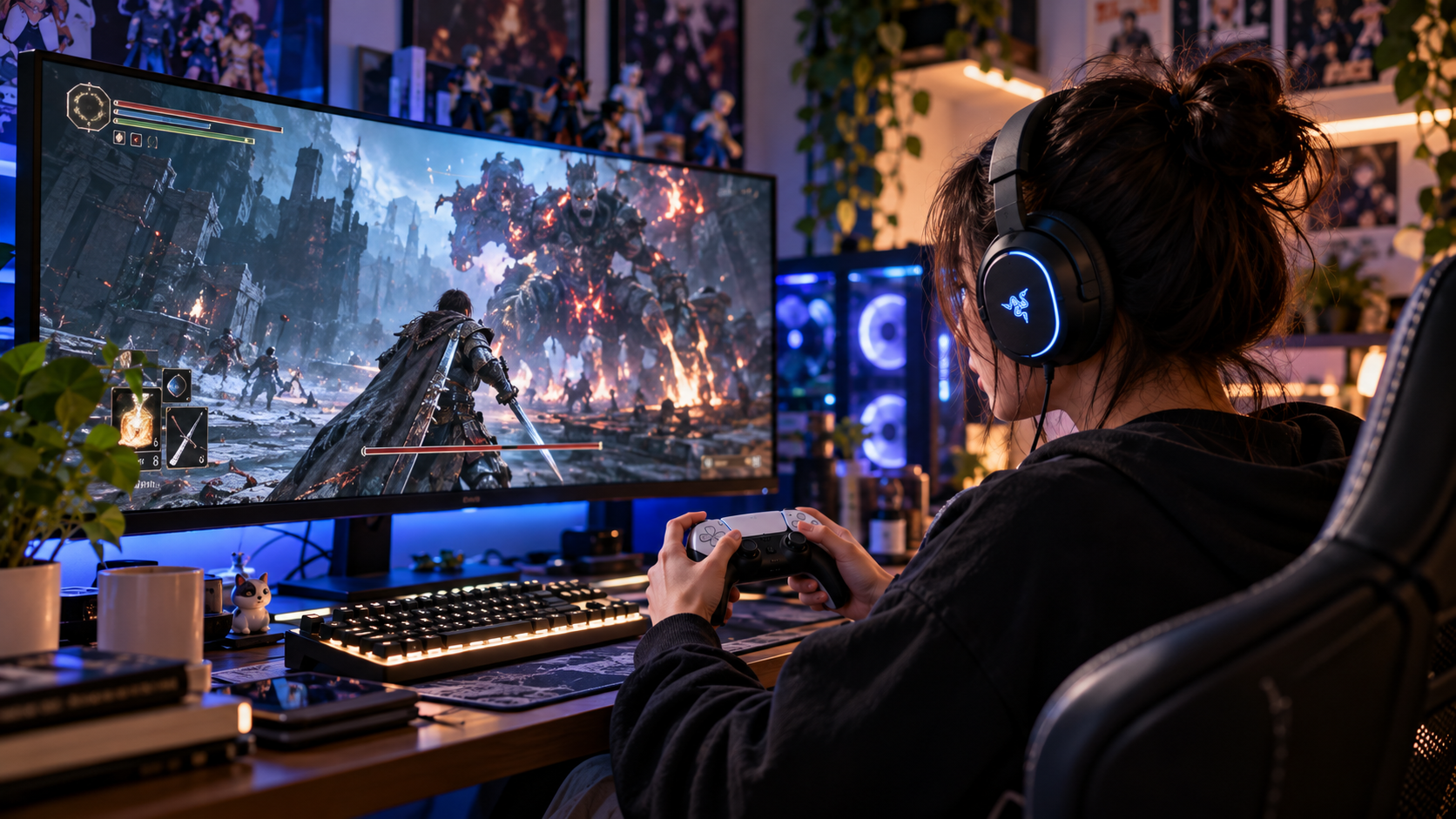
You have already died six times.
The boss still has most of its health. Your inventory contains items you barely understand. The map seems unnecessarily confusing, enemies interrupt every attempt to experiment, and the controls still require a moment of conscious thought before your fingers do what you intended.
At some point, the obvious question appears:
Am I simply bad at this game?
Then something strange happens.
You keep playing.
A few hours later, the same enemies that caused panic barely slow you down. You stop staring at the controller before pressing an unfamiliar button. You recognize attacks before they happen. You know which items matter, where danger usually comes from, and when a fight is worth avoiding entirely.
The game has not necessarily become easier.
You have become better at understanding it.
That difference sits at the heart of the video game learning curve. Learning a game is not only about improving reaction speed or memorizing controls. Players gradually build an internal understanding of rules, patterns, timing, priorities, space, risk, and consequences.
Once enough of those pieces connect, a game that initially felt chaotic can suddenly feel surprisingly readable.
At First, Your Brain Is Trying to Learn Everything at Once
Starting an unfamiliar game creates an enormous information problem.
You need to learn how to move.
How the camera behaves.
What each button does.
Which objects can be interacted with.
What the HUD represents.
How health works.
Whether stamina matters.
What enemies are dangerous.
Where objectives appear.
Which resources are valuable.
What happens when you die.
An experienced player may process some of these things almost automatically, especially when the game follows conventions from a familiar genre.
But genuinely unfamiliar systems demand attention.
That creates cognitive competition.
You cannot focus completely on the enemy because part of your attention is still occupied remembering which button dodges.
You cannot plan your next move because you are still trying to understand what the icons on the screen mean.
The early game therefore feels difficult partly because everything is new simultaneously.
Controls Eventually Stop Feeling Like Instructions
Think about the first time you use an unfamiliar control scheme.
You want to perform an action.
First, you think about the action.
Then you remember the button.
Then you press it.
There is a tiny mental delay between intention and execution.
After enough repetition, that process changes.
You no longer consciously think:
“I need to press this button to dodge.”
You see the attack and dodge.
The control becomes connected directly to the intention.
This frees attention for more complicated decisions.
Instead of thinking about how to move your character, you can think about where you should move.
Instead of thinking about which button attacks, you can think about when attacking is safe.
That transition is one of the biggest reasons difficult games begin feeling easier.
Your fingers have not magically become faster.
Your brain simply has fewer basic decisions to consciously manage.
Experienced Gamers Are Often Learning Less Than Beginners
Give the same new game to two players and their first hour can look completely different.
One appears immediately comfortable.
The other struggles with almost everything.
It is tempting to conclude that one person simply has better gaming ability.
Sometimes experience explains much of the difference.
Games share a vocabulary.
A red bar probably represents health.
A glowing object probably deserves attention.
A large arena with suspicious amounts of empty space might be preparing you for a boss.
A checkpoint usually means something.
Certain controller buttons tend to perform similar functions across games in the same genre.
Experienced players carry this knowledge from previous games.
They are not starting from zero.
A player who has spent hundreds of hours with action RPGs can enter another action RPG already understanding concepts the game has not explicitly explained.
That accumulated genre knowledge shortens the video game learning curve considerably.
Difficulty Often Comes From Not Knowing What Matters Yet
New players frequently pay attention to the wrong information.
Everything appears equally important because they have not learned what deserves priority.
Consider a combat encounter.
A beginner may focus almost entirely on their own character.
An experienced player may barely look at their character at all.
Their attention is on the enemy.
Specifically, they are watching the enemy’s animation.
The shoulder moves.
The weapon rises.
There is a pause.
The attack comes.
That animation contains information.
Once the player recognizes it, the encounter changes.
What previously seemed like an unpredictable attack becomes a recognizable sequence.
The same principle applies outside combat.
A particular sound may signal danger.
A visual effect may indicate an interactable object.
A map symbol may reveal a useful destination.
Experience teaches players which information matters and which can safely be ignored.
Enemies Stop Looking Random When You Recognize Their Patterns
The first time an enemy attacks, you do not know what is coming.
The second time, you have a little information.
After several encounters, patterns begin forming.
Perhaps the enemy always performs two quick attacks followed by a longer recovery.
Maybe it becomes aggressive when its health drops below a certain point.
Perhaps a ranged enemy moves away whenever you get close.
Maybe a boss raises one arm before an area attack and another before a single-target strike.
These patterns turn reaction into prediction.
That is a major shift.
Reacting requires seeing something happen and responding quickly enough.
Predicting allows you to prepare before the dangerous part occurs.
Suddenly, the player who was constantly one step behind can become one step ahead.
The enemy has not slowed down.
The player simply understands its language.
Failure Is Often Giving You Information
Death screens feel like failure because the immediate objective was not completed.
But many games use failure as part of the learning process.
You attack during an unsafe opening.
You learn when not to attack.
You walk into a trap.
Now you know where it is.
You use the wrong damage type.
You notice the fight takes much longer.
You ignore a particular enemy.
It becomes the reason you lose.
Each failed attempt can reveal information.
The useful question after losing is therefore not always:
“How do I play better?”
Sometimes it is:
“What did that attempt teach me?”
This change in perspective can make difficult games considerably less frustrating.
A failed attempt that reveals something is not identical to an attempt where nothing was learned.
Repeating the Same Mistake Is Different From Practicing
Repetition alone does not guarantee improvement.
A player can repeat the same encounter twenty times while making the same mistake twenty times.
That is repetition.
Practice requires adjustment.
Maybe you attack less aggressively.
Change equipment.
Watch the enemy instead of your own character.
Try a different route.
Save a resource for later.
Experiment with positioning.
Use an ability you previously ignored.
Each attempt becomes a small test.
If something works better, keep it.
If it makes the situation worse, you have still learned something.
Progress becomes faster when attempts produce information rather than simply repeating frustration.
Slow Down When the Game Is Punishing Panic
Many difficult games become dramatically harder when the player panics.
An enemy attacks.
You dodge repeatedly.
Now your stamina is gone.
You press attack several times.
The first strike misses, but the queued inputs continue.
The enemy retaliates.
You heal immediately.
The healing animation leaves you vulnerable.
You take another hit.
Everything collapses within seconds.
The instinct is to play faster because the situation feels dangerous.
Sometimes the correct response is the opposite.
Slow down.
Observe.
Make one deliberate input.
Wait for the result.
Then make the next decision.
A surprising number of difficult encounters become manageable when the player stops trying to solve everything simultaneously.
Button Mashing Hides Useful Information
Rapid inputs can feel productive.
You are doing something.
But constant button pressing makes it difficult to understand why actions succeed or fail.
Did your attack miss because of range?
Timing?
Enemy movement?
Was your dodge late?
Or did another input prevent it from happening?
Deliberate inputs create clearer feedback.
Press once.
Observe.
Move.
Observe.
Attack.
Observe.
This does not mean every game should be played slowly.
Fast games obviously require fast decisions.
But speed becomes more useful after you understand what your inputs are accomplishing.
Learning accuracy first often makes speed easier later.
Positioning Can Matter More Than Mechanical Skill
Players often describe difficult games in terms of reflexes.
Sometimes reflexes are genuinely important.
But positioning can eliminate the need for extraordinary reactions.
Standing in the correct place can make an attack miss automatically.
Using cover can remove several threats from view.
Keeping enemies in front of you prevents attacks from arriving from multiple directions.
Maintaining distance can give you more time to react.
Moving toward open space can prevent the camera from becoming trapped against a wall.
Before assuming an encounter requires faster hands, examine where you are standing.
Sometimes the easiest attack to dodge is the one that never reaches you.
The Camera Is Part of the Game Too
In three-dimensional games, camera control is an underrated skill.
New players frequently focus on character movement while treating the camera as a secondary task.
That can create problems.
Enemies leave the screen.
Distances become difficult to judge.
Navigation feels confusing.
Attacks arrive from unexpected directions.
As camera movement becomes automatic, spatial awareness improves.
You begin positioning the view before entering an area.
You turn the camera while moving.
You check corners.
You keep important enemies visible.
The game world starts feeling less chaotic because you are controlling not only where the character moves but also what information is available on screen.
Learn the Game’s Economy Before Spending Everything
Many games introduce currencies, crafting materials, upgrade points, ammunition, consumables, or other limited resources early.
Beginners face an uncomfortable problem.
They do not yet know what is valuable.
An item may look rare but become common later.
Another may look ordinary but be essential for upgrades.
A powerful consumable might be useful now but significantly more valuable during a difficult encounter later.
You do not need to hoard everything forever.
But when the economy is unfamiliar, spending slowly can give you time to understand what resources actually do.
Read descriptions.
Compare costs.
Notice what can be obtained repeatedly.
Understand whether decisions are reversible.
Resource knowledge is another form of player skill.
Stop Saving Every Consumable for a Future That Never Comes
There is an opposite problem.
Players often save powerful items indefinitely.
“This might be useful later.”
Later arrives.
The item is still saved because an even harder encounter might appear.
Then the credits roll with twenty powerful consumables untouched.
If the game provides tools, consider using them when they solve a real problem.
Consumables can be part of the intended strategy rather than emergency buttons reserved for hypothetical disasters.
A difficult encounter may become manageable with an item you have been carrying for five hours.
Using available systems is not cheating.
It is playing the game.
Read Item Descriptions Before Searching for a Guide
When players become stuck, searching online is tempting.
Sometimes a guide is exactly what you need.
But first, inspect the information the game already provides.
Read item descriptions.
Check skill explanations.
Look at status effects.
Review the controls.
Open the map legend.
Examine equipment statistics.
Games frequently explain more than players initially notice.
This information can reveal mechanics without completely removing the satisfaction of discovering a solution yourself.
It also improves your understanding of the game’s language.
A guide can tell you what to do.
Understanding the system tells you why it works.
Tutorials Cannot Teach Everything Before You Need It
A tutorial faces a difficult design problem.
Explain too little and players feel lost.
Explain too much and they forget most of it.
Game-design discussions have long emphasized that effective tutorials work better when players actively use mechanics and learn concepts gradually instead of receiving a large block of instructions before those concepts become relevant. GDC Vault
This explains why you may encounter a mechanic hours after the game technically introduced it and think:
“Wait, when did it teach me this?”
The information arrived before you had enough context to understand why it mattered.
Learning often becomes easier when knowledge appears near the moment you actually need it.
Do Not Be Embarrassed to Revisit the Tutorial
Players sometimes treat tutorials as something they should graduate from permanently.
That makes little sense.
If you stopped playing for several weeks, controls can become unfamiliar.
If a mechanic seemed irrelevant during the opening hour, its explanation may become useful later.
If the game has a training area, glossary, help menu, practice mode, or tutorial archive, use it.
Good tutorial design often keeps important information accessible because players may need to revisit concepts after their first introduction. Game Developer
Refreshing your memory is not starting over.
It is removing unnecessary friction.
Learn One System at a Time
Complex games can become overwhelming because several systems are available simultaneously.
Crafting.
Equipment.
Skills.
Companions.
Status effects.
Elemental interactions.
Parrying.
Dodging.
Combos.
Base building.
Trading.
Upgrades.
Trying to master everything immediately is unnecessary.
Identify the system currently blocking progress.
If combat feels impossible, focus on combat.
If you constantly run out of resources, understand the economy.
If navigation is the problem, learn the map.
Once one system becomes comfortable, move to another.
Complexity becomes manageable when it is divided into smaller problems.
Use Safe Areas to Experiment
Many players only test mechanics when something dangerous is happening.
That is the worst possible time to learn.
If the game provides a training room, empty area, weak enemies, or safe hub, experiment there.
Test attack range.
Try different combinations.
Learn how long healing takes.
Check whether an ability can be cancelled.
Compare movement speeds.
Understand how quickly stamina returns.
See what happens when you hold rather than tap a button.
Experimentation turns abstract descriptions into physical memory.
Five minutes of intentional testing can sometimes teach more than an hour of panicked combat.
Change One Thing at a Time When You Are Stuck
Suppose you lose a boss fight.
Then you change your weapon, armor, skills, consumables, strategy, and control settings simultaneously.
You win.
What actually helped?
You do not know.
Changing one or two variables at a time creates clearer feedback.
Try a different weapon.
Did the fight improve?
Adjust positioning.
What changed?
Use a defensive ability.
Did survivability increase?
This approach may sound analytical, but it becomes intuitive quickly.
Games constantly provide feedback.
The easier it is to identify what caused that feedback, the faster you can learn.
Difficulty Settings Are Tools, Not Tests of Identity
Some games offer multiple difficulty options.
Players occasionally treat the menu like a judgment.
Easy means bad player.
Hard means good player.
That interpretation ignores why people play games.
Someone may want a demanding mechanical challenge.
Another person may primarily care about exploration or narrative.
Someone may have limited time.
Another may be learning the genre for the first time.
Accessibility and difficulty options can allow different players to engage with the same underlying game in different ways. The broader design challenge is giving players enough support to learn without removing the systems that make the experience interesting. GDC Vault
Choose settings based on the experience you want.
The game is entertainment, not an entrance examination.
Sometimes Lowering Difficulty Helps You Learn Faster
Interestingly, reducing difficulty does not always mean avoiding learning.
It can create space for learning.
If enemies kill you so quickly that you barely have time to observe them, a lower difficulty may let you understand their patterns.
Once the mechanics become familiar, you can increase the challenge later if you want.
The same principle applies to assists.
A racing game’s driving assists may help someone learn braking points and track layouts before managing every aspect of the vehicle.
A fighting game’s training tools can isolate mechanics before the player deals with a live opponent.
Reducing simultaneous demands can make individual skills easier to understand.
Do Not Copy Advanced Players Before Understanding Why Their Strategy Works
You watch an expert.
They use unusual equipment.
Play extremely aggressively.
Ignore defensive upgrades.
Take a dangerous shortcut.
Defeat the boss in seconds.
You copy the setup.
It does not work.
Advanced strategies often depend on knowledge that is invisible in the final result.
The player understands enemy timing.
They know exact ranges.
They recognize openings.
They know which risks are calculated and which would be disastrous.
Copying the visible action without the underlying knowledge can make the game harder.
Use expert play as information.
Ask why the strategy works.
Then decide whether the same reasoning applies to your current skill level.
Guides Are Most Useful When They Explain the Problem
There is a difference between a guide that says:
“Equip this weapon and stand here.”
and one that explains:
“This enemy punishes long animations, so faster attacks create safer opportunities.”
The first solves one encounter.
The second teaches something transferable.
When using guides, look for explanations.
Why is this weapon effective?
Why does this route work?
Why should this upgrade come first?
Why is the player positioning themselves there?
Understanding the reasoning allows you to adapt when circumstances change.
That is especially valuable in games with different builds, procedural elements, patches, or multiple viable strategies.
Watching Better Players Can Train Your Eyes
Watching gameplay can improve more than your knowledge of builds.
Pay attention to what experienced players notice.
Where is their camera positioned?
When do they stop attacking?
What do they do immediately after entering a room?
How do they move when several enemies appear?
When do they heal?
What resources do they ignore?
Where do they look before jumping?
The biggest difference may not be mechanical speed.
It may be information management.
Experienced players often appear calm because they know what deserves attention.
Learning where to look can improve your own gameplay dramatically.
Take Breaks Before Frustration Turns Into Worse Play
You have almost beaten the boss.
One more attempt.
You lose.
Another attempt.
You die even earlier.
Now you are annoyed.
Another attempt.
You begin making mistakes you were not making twenty minutes ago.
At this point, persistence may stop being useful.
Frustration changes decision-making.
Players rush.
They become greedy.
They repeat actions impulsively.
They stop observing.
A short break can interrupt that cycle.
When you return, the encounter may feel strangely slower.
Nothing changed inside the game.
Your attention did.
Sleep Can Make Yesterday’s Problem Feel Easier
Many players have experienced this.
A level seems impossible at night.
You stop playing.
The next day, you clear it within several attempts.
Part of the difference may simply be reduced fatigue and frustration.
But the broader lesson is useful:
Progress does not always happen visibly while you are playing.
Learning involves repetition, memory, and familiarity.
Walking away does not erase the practice you already completed.
Sometimes forcing another hour into an exhausted session provides less value than returning with fresh attention.
Plateaus Are Normal
Improvement is rarely linear.
At first, progress can happen quickly.
You learn the controls.
Understand basic enemies.
Unlock useful abilities.
Then improvement seems to stop.
This is a plateau.
The obvious mechanics are already familiar, while the next level of improvement requires subtler changes.
Better timing.
More efficient movement.
Stronger positioning.
Resource management.
Matchup knowledge.
Map awareness.
Decision-making under pressure.
Plateaus can feel like failure because the improvement is harder to notice.
Often they simply mean the easiest lessons have already been learned.
Identify the Specific Reason You Are Losing
“I am bad at this game” is almost useless information.
Try making the problem smaller.
Are you dying because you cannot recognize one particular attack?
Because you are healing at unsafe moments?
Because you enter fights without enough resources?
Because you become surrounded?
Because you do not understand the upgrade system?
Because the camera keeps losing the enemy?
Because you attack too many times before retreating?
Specific problems can have specific solutions.
Vague frustration cannot.
The moment you can describe why something is going wrong, the problem usually becomes easier to work on.
Progress Is Not Always Represented by Winning
Imagine two attempts against the same boss.
During the first, you survive for thirty seconds and barely understand what happened.
During the second, you survive for four minutes, recognize every major attack, consistently reach the final phase, and lose because of one mistake.
The result screen says you lost both times.
Those attempts are not equivalent.
The second contains enormous progress.
Games often measure outcomes clearly while leaving learning invisible.
Players benefit from noticing both.
Did you reach farther?
Use fewer healing items?
Avoid an attack that previously hit every time?
Navigate the level without checking the map?
Those improvements eventually produce the visible victory.
A Difficult Game Can Become Comfortable Without Becoming Easy
This is one of the strangest parts of learning games.
The challenge may remain.
Enemies still deal significant damage.
Bosses still punish mistakes.
Opponents online are still unpredictable.
The game does not necessarily become easy.
It becomes familiar.
You understand what the game expects.
You recognize danger.
You know which mistakes belong to you rather than blaming the controls or assuming the game is random.
That familiarity creates confidence.
And confidence reduces panic.
Different Genres Teach Different Kinds of Awareness
A player can be excellent at one genre and feel completely lost in another.
That makes sense.
Competitive shooters reward aim, positioning, map knowledge, sound awareness, and fast decisions.
Strategy games may emphasize resource management, planning, information, and long-term consequences.
Fighting games demand matchup knowledge, spacing, timing, and pattern recognition.
Racing games emphasize lines, braking, acceleration, consistency, and track knowledge.
Survival games may reward preparation, resource awareness, exploration, and risk management.
Skills can transfer between genres, but not perfectly.
Being an experienced gamer does not mean instantly mastering every type of game.
Sometimes you are simply a beginner again.
Multiplayer Adds a Learning Curve That Never Completely Stops
Single-player enemies follow systems created by developers.
Human opponents adapt.
You use the same strategy repeatedly.
They notice.
You become defensive.
They exploit your passivity.
You rush aggressively.
They prepare for it.
This makes competitive multiplayer learning especially deep.
Mechanical skill matters, but so does understanding tendencies, predicting decisions, controlling information, and adapting.
You are learning the game while simultaneously learning the person playing against you.
That is why multiplayer games can remain challenging for thousands of hours.
The system may be familiar.
The situations keep changing.
The Moment Everything “Clicks” Is Usually Built From Hundreds of Small Lessons
Improvement can feel sudden.
Yesterday the game was impossible.
Today it makes sense.
But the change was probably not actually instantaneous.
Every failed encounter taught you something.
Every repeated input improved familiarity.
Every map route strengthened spatial memory.
Every enemy animation became easier to recognize.
Every experiment clarified another mechanic.
Eventually enough small lessons connected.
That is the video game learning curve in practice.
The game stops feeling like a collection of unrelated rules and starts feeling like a system you understand.
You are no longer asking what every button does.
You are deciding when to use it.
You are no longer surprised by every enemy attack.
You are anticipating it.
You are no longer following instructions one step at a time.
You are making decisions.
And that is usually the point where a difficult game becomes genuinely satisfying.
Not because the game finally stopped challenging you.
Because you finally learned how to speak its language.