
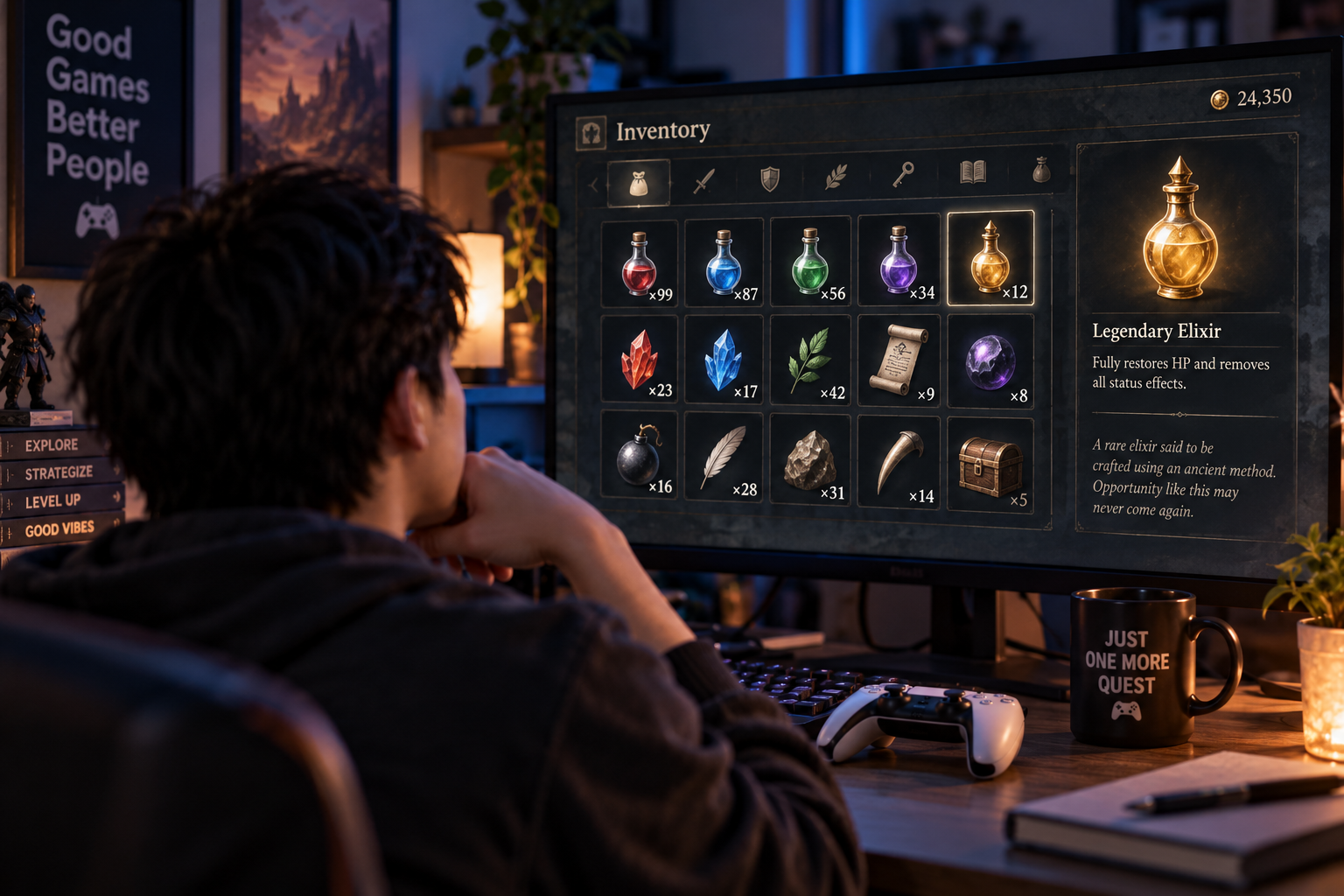
You find a powerful potion early in an RPG.
The description makes it sound valuable. It fully restores health, removes negative effects, and may be difficult to replace. Using it during an ordinary fight feels wasteful, so you save it for something more dangerous.
A difficult boss arrives.
You still do not use it.
There might be another phase. There might be a harder boss later. Perhaps you will need the potion more urgently in the final area.
Hours pass. The credits eventually roll.
The potion is still sitting in your inventory.
This behavior is so common that understanding why players hoard items in games reveals something interesting about resource management, game design, and the way players respond to uncertainty.
Players Are Not Hoarding Because They Forget the Item Exists
Sometimes we genuinely forget what is buried inside a large inventory.
But that does not explain the entire phenomenon.
Many players know perfectly well that they have powerful consumables available. They deliberately choose not to use them because spending a limited resource creates another decision:
What if I need it more later?
That possibility gives the item value beyond what its stats say.
A potion is no longer simply 100 points of healing. It becomes protection against an unknown future problem.
The less players know about what is coming, the harder that protection can be to surrender.
Scarcity Changes How an Item Feels
Imagine a game gives you 99 healing potions and every shop sells more.
Using one barely requires thought.
Now imagine the game gives you a mysterious elixir, and after 15 hours you have found only two.
The decision changes completely.
Even if the elixir would be useful right now, its apparent scarcity makes spending it feel significant.
Players start asking whether the current situation is sufficiently important to justify the cost.
This is one reason rare consumables often remain unused precisely because they are powerful.
Their rarity makes them feel too valuable to spend.
“I Might Need It Later” Has No Clear Ending
The strange part is that “later” keeps moving.
At level 10, you save the item for level 20.
At level 20, you assume level 30 will be harder.
Then the final dungeon appears and you still hesitate because there could be a final boss with several phases.
Games frequently escalate their challenges, so this thinking is not completely irrational.
The problem is that players rarely know when the future value of an item has finally become lower than its value right now.
Without that certainty, saving becomes the safest default.
Consumables Create a Different Kind of Decision Than Equipment
Finding a stronger sword is easy to understand.
Equip it and the character becomes stronger.
The sword remains available after the next fight.
Consumables are different because using them destroys the resource. The player receives an immediate benefit but gives up future optionality.
That makes the decision psychologically heavier.
Permanent upgrades feel like progress.
Consumables can feel like spending progress.
Good resource systems have to overcome that perception.
Games Sometimes Train Players to Be Stingy
Player behavior does not develop in isolation.
Games teach habits.
If an early game frequently leaves players without healing, ammunition, crafting materials, or money, they learn that resources cannot be trusted.
The logical response is conservation.
Later, the economy may become generous, but the behavior remains.
A player who learned during the first five hours that every potion matters may continue treating potions as precious during hour 40 when they have enough money to buy dozens.
The economy changed.
The player’s mental model did not.
Unclear Drop Rates Make Hoarding Worse
Suppose you use a rare grenade.
Can you buy another one?
Will enemies drop it?
Is there a crafting recipe?
Does the next area contain more?
If the game does not communicate resource availability clearly, players have difficulty estimating the real cost of using an item.
Uncertainty encourages caution.
This is why two equally powerful consumables can produce very different behavior depending on how easily players understand their supply.
A rare item with a known source may actually get used more often than a moderately rare item whose availability is mysterious.
Inventory Numbers Can Become a Score of Their Own
There is another funny transformation that happens over long games.
Players begin enjoying the collection itself.
Thirty health potions becomes 40.
Then 50.
Watching the number increase creates its own small sense of progress.
At that point, using an item can feel like watching a score decrease.
The inventory was originally supposed to support gameplay, but collecting resources has become part of the gameplay.
This is especially common in games filled with crafting ingredients, ammunition types, food, potions, scrolls, and temporary buffs.
The More Complicated the Inventory, the Easier It Is to Save Everything
Large inventories introduce decision friction.
You open the menu and discover:
three healing items,
four resistance potions,
six throwable weapons,
several temporary buffs,
food with different effects,
scrolls,
bombs,
and materials whose purpose is still unclear.
Which one should you use?
Closing the menu and continuing with your normal weapon is easier.
This is not necessarily deliberate hoarding. Sometimes the player simply does not want to interrupt the action to evaluate twenty options.
Players Prefer Reliable Strategies
Once players discover something that consistently works, they tend to repeat it.
Maybe normal attacks are enough.
Maybe dodging and healing with a renewable ability gets the job done.
Consumables then become emergency tools rather than part of the normal combat loop.
But if the regular strategy succeeds most of the time, the emergency never feels serious enough.
Even a difficult fight may produce the thought:
“I almost beat it without items. One more attempt.”
The player retries instead of opening the inventory.
Failure Can Make Players Hoard Even More
You might expect a difficult encounter to encourage item use.
Sometimes it does the opposite.
Imagine spending three rare consumables during a boss fight and still losing.
The game reloads.
Those items may remain consumed depending on the save system.
Now you lost the fight and the resources.
That experience teaches a powerful lesson.
Do not spend valuable items until you are confident the attempt will succeed.
Unfortunately, players often become confident only after they have already learned the fight well enough that the consumables are no longer necessary.
Checkpoints Influence Resource Behavior
Save systems quietly change how players think about inventory.
If consumables return after death, experimentation is cheap.
Use the grenade.
Drink the resistance potion.
Try the temporary damage buff.
If it fails, restart and test something else.
When consumed resources remain lost after failure, experimentation becomes expensive.
Players naturally become more conservative.
This shows how resource management in games is connected to systems far beyond the inventory screen itself.
Boss Fights Create the Ultimate “What If?”
Bosses seem like the obvious place to spend rare items.
Yet bosses also create maximum uncertainty.
How many phases are there?
Will the health bar refill?
Is this even the real final boss?
Will there be another fight before the next checkpoint?
Players familiar with games have learned not to trust apparent endings.
That knowledge can become its own trap.
You keep waiting for the “real” emergency until there are no emergencies left.
Final Bosses Do Not Completely Solve the Problem
Even when the game clearly signals its final encounter, some players still conserve resources.
Why?
Because habits have already formed.
If you spent 40 hours solving every challenge without relying on consumables, suddenly rebuilding your strategy around them during the final battle can feel unnatural.
You may also not remember exactly what half the items do.
The inventory contains incredible power, but you have never practiced using it.
This highlights an important design principle: if developers want players to use a mechanic, the game should encourage that behavior before the final hours.
Renewable Resources Feel Easier to Spend
Players are much more comfortable spending something when they know it will return.
An ability that recharges after combat invites experimentation.
A flask that refills at checkpoints feels usable.
A grenade that can be cheaply crafted feels replaceable.
A unique potion with no known source feels precious.
The gameplay effect may be similar, but the resource model changes player psychology dramatically.
Renewability gives players permission to experiment.
Capacity Limits Can Actually Encourage Item Use
Suppose the player can carry only five grenades.
They currently have five.
Another grenade is lying on the ground.
Suddenly using one does not feel wasteful.
If you refuse, you cannot pick up the new grenade anyway.
A carrying limit changes the question from:
“Should I lose one grenade?”
to:
“Should I use one grenade or leave a free grenade behind?”
The second question strongly encourages action.
This is why inventory caps can sometimes improve resource usage rather than merely restricting players.
Games Can Create “Use It or Lose It” Moments
Temporary opportunities also reduce hoarding.
Perhaps a special weapon exists only inside one mission.
Maybe a buff disappears after leaving an area.
Perhaps unused resources do not transfer into the next chapter.
Now the future-value problem disappears.
There is no reason to save something forever because forever is no longer an option.
The game gives the player a clear spending horizon.
That certainty can make consumables much more enjoyable.
Good Encounter Design Gives Items a Purpose
Players are more likely to use resources when the game creates recognizable situations for them.
A poison resistance potion becomes meaningful before an area filled with poisonous enemies.
An anti-armor grenade makes sense against heavily armored targets.
A temporary fire buff becomes tempting when facing enemies visibly weak to fire.
The decision becomes contextual rather than abstract.
Instead of asking whether an item is “valuable enough” to use, the player sees a problem the item was clearly designed to solve.
Strong Items Should Feel Useful, Not Sacred
There is a strange design problem with extremely powerful consumables.
Make them too weak and nobody cares about them.
Make them very powerful but extremely rare and players may refuse to use them.
The ideal balance often gives the item meaningful impact while also making the player confident that spending it is legitimate.
That confidence can come from crafting, shops, predictable drops, refill systems, carrying limits, or simply good communication.
Power alone does not guarantee use.
Crafting Can Solve Hoarding—or Make It Worse
Crafting systems theoretically make consumables easier to replace.
If players know they can craft another bomb, using one becomes less intimidating.
But crafting can introduce a new uncertainty.
“What if I need these materials for a better weapon later?”
Now the player is not hoarding the bomb.
They are hoarding the ingredients required to make the bomb.
Resource anxiety simply moves one level deeper into the system.
Clear material purposes and balanced economies help prevent this.
Money Often Gets Hoarded for the Same Reason
The behavior is not limited to consumables.
Players frequently finish RPGs with enormous amounts of currency.
Early in the game, money is scarce.
Purchases require trade-offs.
Eventually, income increases, but players continue behaving as if financial disaster is one bad purchase away.
They avoid expensive weapons because something better might appear in the next town.
Then the final town arrives.
The wallet is full.
The game ends.
The same uncertainty that preserves potions can preserve currency.
Rare Ammunition Creates Similar Behavior
Games with multiple ammunition types create another version of the problem.
Common pistol rounds get used freely.
Rockets, explosive shells, or specialized ammunition may remain untouched.
Players save them for powerful enemies.
Then when powerful enemies appear, they try defeating them with ordinary ammunition first.
If that works, the rare ammo remains unused.
Again, the resource is valuable enough to save but apparently never valuable enough to spend.
Knowledge Changes the Way Players Use Resources
Second playthroughs can feel completely different.
Now you know where the difficult fights are.
You know which items become plentiful.
You know which merchants sell replacements.
You know that the “rare” potion from the opening area becomes common later.
Uncertainty disappears.
As a result, players often use resources much more aggressively.
The game did not change.
Information changed the perceived cost of every item.
Hoarding Is Not Always Bad Play
It is tempting to describe item hoarding as irrational.
That is too simple.
Conserving resources is a legitimate strategy, especially in games where supplies are genuinely limited and future challenges are unknown.
Some players also enjoy collecting.
Others enjoy beating encounters without consumables because it creates an additional personal challenge.
There is no requirement that every item must be used.
The interesting question is whether the player is making an intentional choice or avoiding useful mechanics because of unnecessary anxiety about scarcity.
A Simple Rule: Use Resources to Solve Expensive Problems
Players who want to break the habit do not need to suddenly consume everything.
Instead, reconsider what “waste” means.
If a potion prevents ten minutes of repeating an encounter, was it wasted?
If a grenade prevents major damage, was saving the grenade really more valuable?
If a buff helps defeat a boss on the current attempt, does it matter that you might theoretically want it later?
Resources exist to create advantages.
An item sitting permanently in inventory provides no gameplay benefit beyond the comfort of owning it.
Set Personal Thresholds
A practical approach is to create simple rules.
For example, if you have more than ten healing potions, anything above ten can be used freely.
If ammunition reaches maximum capacity, spend some before collecting more.
If a boss defeats you several times, try the consumables designed for that encounter.
These rules reduce repeated decision-making.
Instead of evaluating the entire future of the game every time you open the inventory, you already know when spending is acceptable.
Experiment Before You Desperately Need the Item
Do not wait until the hardest boss to learn what a consumable does.
Try items in lower-risk situations.
Learn their range.
Duration.
Animation.
Damage.
Side effects.
Once an item becomes familiar, it is easier to integrate into your strategy.
An inventory full of mysterious icons feels like emergency storage.
An inventory full of tools you understand feels like a toolkit.
The Inventory Is Part of Your Character’s Power
Players often think about character strength through levels, weapons, armor, and skills.
Consumables belong in the same equation.
If your character carries five damage buffs, three powerful bombs, several healing items, and resistance potions, those resources are part of the build.
Ignoring them effectively means choosing to play weaker than necessary.
That can be fun if it is intentional.
But if the game feels frustrating while the solution sits unused inside the inventory, spending a few resources may be smarter than attempting the same fight another ten times.
The Best Time to Use an Item Is Usually Before Disaster
Many players wait until health is nearly zero before using powerful resources.
That can be too late.
Consumables often work best proactively.
Resistance before entering a dangerous area.
Damage buffs at the beginning of an opportunity window.
Crowd-control tools before enemies surround you.
Special ammunition against the target it was designed to defeat.
Resource management becomes more effective when items are treated as tactical tools rather than panic buttons.
Conclusion
Understanding why players hoard items in games comes down largely to uncertainty. Players do not know what challenges are coming, whether a resource can be replaced, or whether the current situation is important enough to justify spending something rare.
Scarcity, save systems, unclear drop rates, crafting economies, boss design, and even inventory interfaces can reinforce that behavior. Once the habit forms, players may continue conserving resources long after scarcity has stopped being a real problem.
There is nothing inherently wrong with finishing a game with extra potions, ammunition, or money. Saving resources can be a legitimate strategy, and collecting them can be enjoyable in its own right.
But if you repeatedly struggle while carrying an inventory full of solutions, it may be worth remembering why those items exist.
The potion was not designed to look impressive in your inventory.