
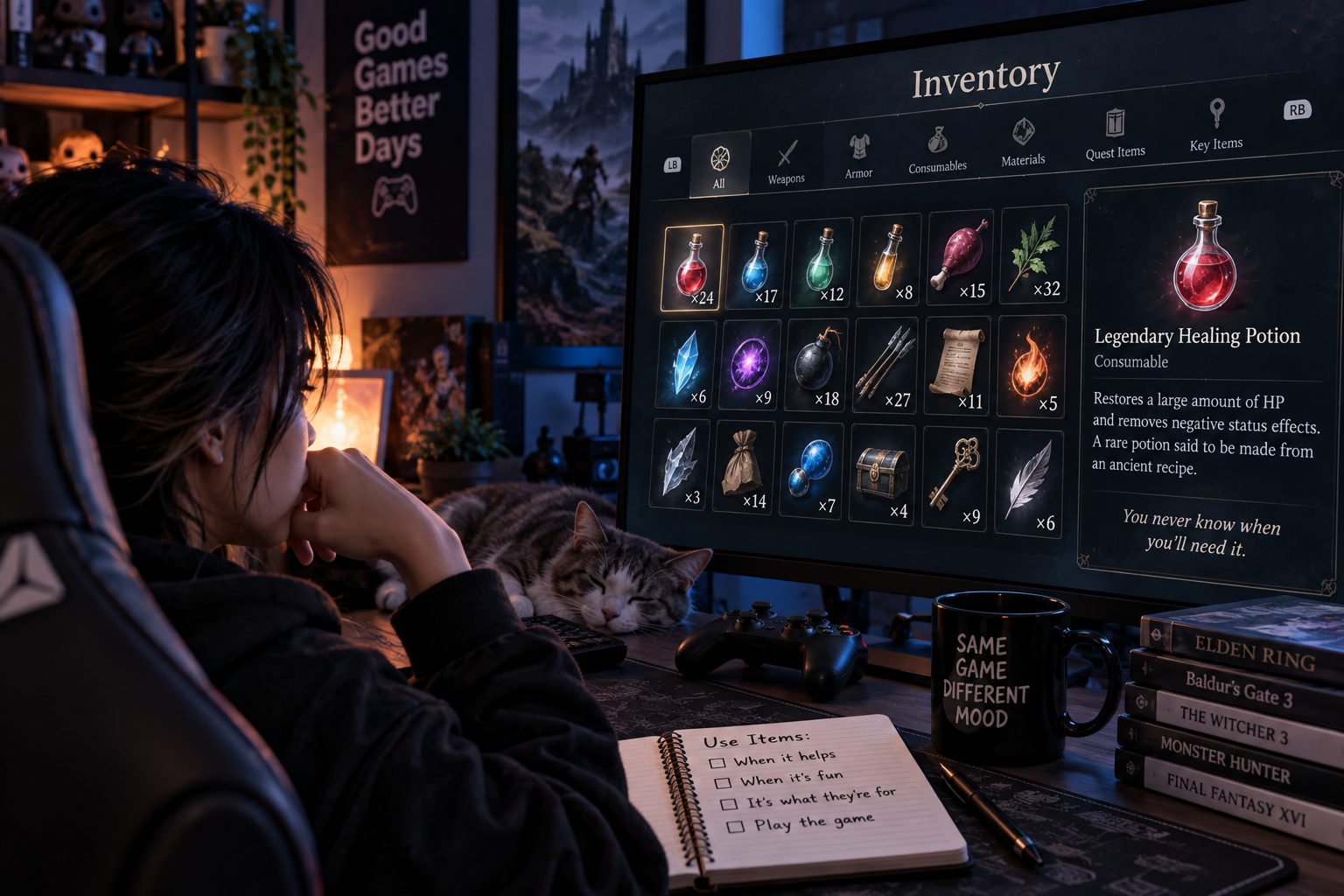
You find an unusually powerful potion early in the game.
The description sounds incredible. It restores a huge amount of health, removes negative effects, and might even provide a temporary bonus.
Using it during an ordinary fight feels wasteful.
So you save it.
Hours later, you survive another difficult encounter without touching it. Then another. Eventually the final credits appear—and that supposedly precious potion is still sitting untouched in your inventory alongside dozens of bombs, scrolls, elixirs, special ammunition, and other consumables you were saving for “later.”
This behavior is so common that it has become a familiar gaming joke. But why players hoard items in games has less to do with simple forgetfulness than it first appears. Uncertainty, scarcity, game design, and our tendency to fear wasting limited resources can make using an item feel more expensive than keeping it.
Consumables Create a Different Decision From Equipment
Finding a new sword usually feels exciting because equipping it does not destroy it.
You can use the weapon in the next encounter and continue using it afterward.
Consumables create a different psychological calculation.
Use the potion once and it disappears.
Throw the rare grenade and your inventory count permanently decreases. Fire special ammunition and you may not know when you will find more.
That permanence creates hesitation.
The player is no longer asking only whether the item would be useful now. They are also wondering whether it could be more useful later.
The Future Encounter Always Looks More Dangerous
Imagine entering a difficult room with three healing items remaining.
You could use one now and make the fight safer.
But what happens after this room?
Maybe there is a boss.
Maybe there is no checkpoint.
Maybe the next area has stronger enemies.
Because the player cannot perfectly predict the future, saving resources feels like protection against uncertainty.
The strange result is that the hypothetical future encounter often receives priority over the very real encounter happening now.
Rare Items Feel More Valuable Than Their Actual Effect
Game interfaces frequently reinforce hoarding through presentation.
An item has a unique icon.
Its description sounds powerful.
You have only one copy.
Perhaps you have not found another one in several hours.
All of those signals tell the player:
This is important.
But perceived rarity and practical usefulness are not necessarily the same thing.
An item that gives a major temporary damage boost may be incredibly valuable during a difficult encounter. If it remains unused for the entire playthrough, however, its practical value was zero.
The item was valuable in theory but never converted into an advantage.
Players Hate the Feeling of Wasting Something
Using a rare resource during an encounter that turns out to be easy can feel bad.
Suppose you drink an expensive elixir.
Thirty seconds later, the enemy dies.
Now you think:
“I didn’t even need that.”
This feeling can be stronger than the satisfaction of making the fight easier.
As a result, players begin demanding certainty before using consumables. They want to know that the situation is sufficiently difficult to justify the resource.
Games rarely provide that certainty in advance.
So the item stays in the inventory.
Reloading Can Reinforce the Habit
Some games allow players to reload an earlier save after an inefficient encounter.
Maybe you used three healing items but realized afterward that you could have won using only one.
Reload.
Try again.
Eventually, conserving resources can become part of the player’s definition of a “good” attempt.
This can be satisfying in survival games where resource management is intentionally central to the challenge.
But in other games, optimization can become so extreme that players avoid using systems specifically designed to help them.
The Inventory Starts Becoming a Collection
After enough hours, another behavior appears.
You stop seeing consumables as tools and start seeing them as possessions.
You have 17 healing potions.
Nine resistance items.
Six explosives.
Three extremely rare buffs.
Watching those numbers increase becomes satisfying.
Using an item now feels like losing progress because the inventory count moves in the wrong direction.
The game intended those resources to create decisions during combat.
The player has accidentally turned them into collectibles.
“I Might Need It Later” Has No Natural Ending
The logic sounds reasonable:
Save the item until you really need it.
The problem is defining really need.
If you survive a difficult fight without the item, apparently you did not need it.
Then you survive the next fight too.
Eventually you reach the final boss carrying everything you saved.
Even there, some players hesitate because the fight has multiple phases.
Maybe there is another form afterward.
Maybe the game continues after the apparent ending.
The perfect moment keeps moving forward until there are no moments left.
Difficulty Can Change How Players Value Resources
On easier settings, players may hoard items because they rarely feel pressured enough to use them.
On harder difficulties, the opposite can happen.
Resources become genuinely scarce, which makes players even more reluctant to spend them.
The ideal behavior depends heavily on the game.
In some survival-horror titles, careful conservation is fundamental to the intended experience. Using every powerful resource immediately can create serious problems later.
In other games, consumables are plentiful and clearly intended for regular use.
Good resource management therefore is not simply “use everything.”
It means understanding the economy of the particular game.
Look at How Easily the Resource Can Be Replaced
One useful question is:
How renewable is this item?
If merchants sell the item cheaply and money is abundant, treating every copy like an irreplaceable treasure makes little sense.
If common enemies regularly drop it, using one during a difficult encounter carries relatively little long-term risk.
On the other hand, an item with only three copies in the entire game deserves different consideration.
The icon’s appearance is less useful than understanding the actual supply.
Players often hoard because they do not yet know whether an item is renewable.
Once the game’s economy becomes clearer, decisions can become much easier.
Money Can Become Another Hoarded Resource
The same behavior extends beyond consumable items.
Players accumulate huge amounts of in-game currency while refusing to buy upgrades because something better might appear at the next shop.
They postpone improving equipment.
Then enemies become harder because their character remains underpowered.
Ironically, refusing to spend resources can make progression more difficult.
Currency generally exists to be converted into some form of advantage.
Saving for an expensive upgrade can be sensible. Saving indefinitely without a specific purpose is different.
Opportunity Cost Exists in Games Too
Keeping a consumable has a cost that is easy to overlook.
Suppose a damage buff could shorten a difficult encounter by two minutes.
Using it might reduce the chance of taking damage, preserve healing items, and prevent a failed attempt.
Saving the buff means giving up those advantages.
The item remains in your inventory, but you paid for that conservation somewhere else.
Maybe you lost health.
Maybe you spent ammunition.
Maybe the fight took longer.
Maybe you died and repeated the entire section.
Resources should therefore be evaluated as part of a larger system rather than individually.
A Healing Item Can Save More Than Health
Players often evaluate a healing potion by asking whether their health is low enough.
But using it can affect the rest of an encounter.
Higher health may allow more confident positioning.
It may prevent a single mistake from causing death.
Avoiding death saves time and preserves whatever progress would otherwise be lost.
That does not mean healing at every small amount of damage.
It means the value of an item can extend beyond the number shown in its description.
Grenades Are Useless After the Fight Is Over
Explosives are a classic example of resource hoarding.
A room contains several dangerous enemies grouped closely together—the exact situation where a grenade would be excellent.
The player instead fights them individually because grenades feel too valuable.
Then the game provides three more grenades shortly afterward.
Learning enemy encounters includes learning when the game is effectively presenting a resource opportunity.
If an item solves the current tactical problem extremely well, that is strong evidence that the current situation may be exactly what the item is for.
Special Ammunition Should Have a Job
Rare ammunition often creates the same hesitation.
Instead of thinking “save this forever,” assign it a purpose.
Perhaps armor-piercing ammunition is reserved for heavily armored enemies.
Fire rounds are used against enemies particularly vulnerable to fire.
High-damage ammunition is saved for elite enemies rather than ordinary targets.
Now the resource has a rule.
This is easier than making a completely new decision every time an enemy appears.
Create Personal Thresholds for Consumables
Players who struggle with hoarding can create simple rules.
For example, use a healing item when health falls below a particular threshold during a dangerous encounter.
Use a temporary damage buff after failing the same fight twice.
Use area-of-effect consumables when several high-threat enemies are grouped together.
The exact rules depend on the game.
The point is to replace vague thinking—“maybe later”—with recognizable situations.
Consumables become tools with jobs rather than emergency artifacts that can never quite justify their own use.
Test Items Before the Endgame
Another common mistake is saving an item so carefully that you never learn how it actually works.
Then the final boss arrives.
You finally use the consumable and discover its animation is slow, its range is tiny, or its effect does not work the way you expected.
Using a renewable version earlier can teach you timing, range, duration, and practical value.
Knowledge is part of resource management.
An item you understand is easier to deploy effectively than one you have admired in the inventory for 30 hours.
Games Sometimes Train Players to Hoard
Players are not solely responsible for this behavior.
Game design can encourage it.
If early areas provide generous resources but later sections suddenly become extremely scarce, players learn that conservation is rewarded.
If rare items cannot be purchased or replaced, using them naturally feels risky.
If the game frequently introduces unexpected boss phases, players learn never to assume an encounter is truly over.
Design teaches behavior.
A player who hoards in one game may use consumables freely in another simply because the two games communicate scarcity differently.
Crafting Systems Can Make the Decision Harder
Crafting adds another layer.
Now using one resource may prevent you from making something else later.
A material could become healing medicine, ammunition, a temporary buff, or an equipment upgrade.
The player is no longer deciding whether to use one item.
They are deciding between several unknown future possibilities.
In these systems, keeping a modest reserve can be sensible.
But once again, reserves work best when they have a purpose.
“Keep five for emergencies” is a strategy.
“Never use any because something might happen later” usually is not.
Inventory Limits Can Actually Help
Limited inventory space sometimes feels annoying, but it can force meaningful decisions.
If you cannot carry another grenade because the inventory is full, leaving useful resources behind creates obvious waste.
Suddenly using one becomes easier to justify.
This reveals something interesting about why players hoard items in games: unlimited storage can remove the pressure that would otherwise encourage consumption.
When there is no downside to keeping everything, saving becomes the default.
A capacity limit gives unused items an immediate opportunity cost.
The Best Players Are Not Always the Most Conservative
Efficient play does not necessarily mean finishing with the largest inventory.
Sometimes efficiency means spending exactly the resources required to make progress reliably.
A player who finishes a difficult game with 40 healing items may look incredibly prepared.
But perhaps they also repeated encounters unnecessarily because they refused to heal.
Another player may finish with five items while experiencing fewer deaths and smoother progression.
Neither inventory number proves superior play by itself.
Resources exist within the broader objective of completing challenges.
Survival Games Are an Important Exception
Not every game rewards aggressive resource use.
In survival and survival-horror games, uncertainty and scarcity may be core mechanics.
The player may genuinely need to decide whether today’s problem deserves tomorrow’s ammunition.
In those games, maintaining reserves is part of strategic play.
Even then, absolute hoarding can become counterproductive.
Dying while carrying every powerful resource is not necessarily better than spending enough to survive.
The interesting decision is finding the balance.
Use Items to Protect the Resource That Matters Most
Sometimes the most valuable resource is not ammunition, money, or potions.
It is time.
If using one common consumable prevents you from repeating a 15-minute section, that may be an excellent trade.
In other games, the most valuable resource might be durability, limited saves, character lives, or another scarce system.
Think beyond the item being consumed.
Ask what spending it protects.
That perspective makes resource decisions much clearer.
The Final Boss Is Not the Only Valid Moment
Powerful items do not need cinematic circumstances to justify their existence.
A difficult optional encounter can be worth using them.
A room that repeatedly kills you can be worth using them.
A section where failure causes substantial lost progress can be worth using them.
The correct moment is not necessarily the most dramatic moment in the game.
It is the moment when the benefit of the resource is greater than the value of continuing to hold it.
Conclusion
Understanding why players hoard items in games explains why inventories often remain packed with powerful resources even after the credits roll.
Consumables create uncertainty because using them is permanent. Players fear wasting something that may become more valuable later, while rare icons, limited supply, unpredictable encounters, and game economies reinforce that hesitation.
The solution is not to use every resource immediately.
Learn how replaceable an item is, understand what tactical problem it solves, maintain sensible reserves when scarcity matters, and create simple rules for when powerful consumables should leave the inventory.
Most importantly, remember what the item was designed to do.
That potion is not valuable because the number beside it stays at 12.
It becomes valuable when using it helps you survive, win, explore, or progress.
Sometimes the perfect moment you have been saving it for is not waiting somewhere near the final boss.
It is the difficult fight happening right now.