
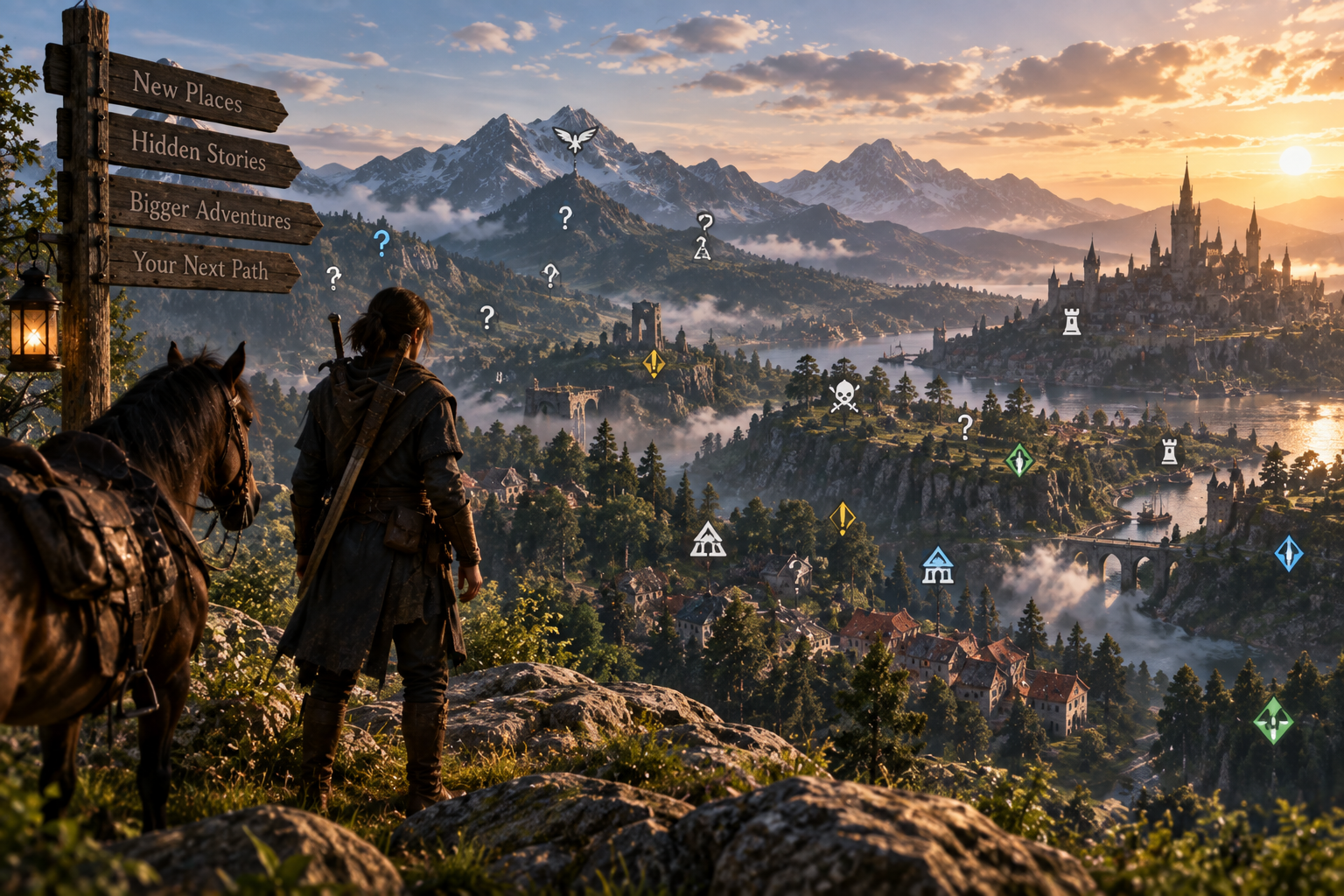
At first, opening the map feels exciting.
There are mountains in the distance, towns you have never visited, hidden caves, side quests, enemy camps, collectibles, mysterious icons, and entire regions still covered by fog.
Twenty hours later, the same map can produce a completely different feeling.
Instead of wondering what might be over the next hill, you open the map and see forty-seven unfinished markers.
Exploration becomes a list.
Reach the tower. Reveal the area. Clear the camp. Collect three items. Visit the question mark. Repeat the process in the next region.
This is one version of open world map fatigue: the moment a game can still contain enormous amounts of content while the player’s desire to explore it begins disappearing.
The problem is not necessarily that the world is too large.
Sometimes the way the world communicates its content changes exploration into administration.
A Large World and an Interesting World Are Not the Same Thing
Map size is easy to communicate.
A developer can show how many square kilometers a game contains, how many regions exist, or how long it takes to cross the world.
But physical size does not automatically create meaningful exploration.
Imagine two forests.
The first covers a huge area but repeatedly uses similar enemies, resources, camps, and activities.
The second is much smaller, but following a strange path might reveal an abandoned structure, an unusual encounter, a hidden character, or an environmental detail that changes how you understand the area.
The first world is larger.
The second may feel more mysterious.
Exploration depends partly on uncertainty, not merely distance.
Map Markers Can Remove the Question From Exploration
Suppose you see an unusual tower on the horizon.
You have no idea what it is.
You decide to investigate.
That journey begins with curiosity.
Now imagine the map already labels the same location with a specific activity icon and tells you what reward is waiting there.
You may still travel to it.
But your motivation has changed.
Instead of asking, “What is that?”
You are thinking, “I need to complete that icon.”
Map markers are useful navigation tools, but excessive information can remove some of the uncertainty that makes exploration exciting.
The Map Can Quietly Become a To-Do List
Icons create unfinished business.
An incomplete marker remains visible.
A region shows 7/12 activities completed.
The menu tells you there are three collectibles nearby.
None of this forces you to finish everything.
Yet visually, the game continuously reminds you what remains undone.
For completion-oriented players, this can create a subtle shift in motivation.
You stop asking what you feel like doing and start asking what still needs to be cleared.
At that point, the open world begins resembling a checklist.
More Content Can Create More Decision Fatigue
Open-world games are often praised for freedom.
Go anywhere.
Do anything.
Choose your own route.
But freedom also requires decisions.
Should you continue the main quest?
Explore the cave?
Complete the contract?
Upgrade equipment?
Clear the nearby camp?
Travel to the new region?
Search for crafting materials?
When choices continuously accumulate, deciding what to do next can itself become tiring.
This is especially noticeable after a long session when the player opens a crowded map and spends several minutes moving the cursor between activities without actually choosing one.
The game offers freedom, but the player experiences friction.
Repeated Activities Make Icons Predictable
The first enemy outpost may be exciting.
You study the layout, identify enemies, decide how to approach, and discover how the activity works.
The fifth can still be enjoyable.
By the twentieth, you may already understand the entire pattern before arriving.
Repeated activity structures are not inherently bad. Familiar systems can provide satisfying gameplay loops.
The problem begins when discovery stops producing meaningful variation.
If every marker of the same type creates nearly the same experience, seeing the icon eventually tells the player almost everything they need to know.
The world becomes easier to categorize and therefore less surprising.
Exploration Changes When Rewards Become Predictable
Imagine discovering a cave without knowing what is inside.
Maybe it contains unusual equipment.
Maybe a side story.
Maybe a dangerous enemy.
Maybe nothing particularly valuable.
That uncertainty creates tension.
Now imagine every cave icon reliably produces the same crafting resource and similar encounter structure.
The decision becomes economic.
“Do I need that material?”
If not, the player may stop exploring caves entirely.
Once rewards become completely predictable, locations can lose some of their identity and become resource containers.
Waypoints Can Make Players Stop Looking at the World
Place a marker on the map.
A line appears.
Follow the compass.
Watch the distance number decrease.
Arrive.
This system is efficient.
It can also change where the player looks.
Instead of studying roads, mountains, buildings, rivers, or landmarks, attention moves toward navigation UI.
Players may travel through a beautifully designed environment while spending much of the journey following a symbol.
The strange result is that better navigation can sometimes reduce engagement with the environment being navigated.
Environmental Navigation Creates a Different Relationship With Space
Some games encourage players to recognize the world itself.
A distant mountain establishes direction.
A large tower can be seen from multiple regions.
Road signs, rivers, coastlines, architecture, lighting, and terrain help communicate where the player is.
When environmental information is strong enough, navigation becomes part of exploration.
The player begins constructing a mental map.
“I know this road.”
“The village is beyond that ridge.”
“That river eventually reaches the southern city.”
This can make a fictional place feel more memorable because the player learns it rather than simply following directions through it.
Fast Travel Solves One Problem and Can Create Another
Large maps eventually make repeated travel expensive in time.
Fast travel solves that problem elegantly.
Once locations are discovered, players can skip journeys they no longer find interesting.
But widespread fast travel can also fragment the sense of geography.
Town.
Loading screen.
Quest location.
Loading screen.
Upgrade vendor.
Loading screen.
The world still exists between those points, but the player increasingly experiences it as a collection of destinations rather than one connected place.
This does not make fast travel bad.
It shows how map scale and navigation systems influence each other.
If repeatedly crossing the world becomes tedious, players naturally search for ways to avoid crossing it.
Content Density Matters More Than Raw Size
A massive landscape can work when its empty spaces contribute to atmosphere, pacing, navigation, or the feeling of traveling somewhere remote.
Likewise, a dense map can work when nearby activities remain varied and meaningful.
Problems arise when scale exists primarily to hold more repetitions of familiar content.
This is why comparing open-world games purely by map size reveals very little about how they actually feel.
A smaller world with strong location identity can provide dozens of memorable discoveries.
A larger world can contain hundreds of activities while leaving players struggling to remember where any of them happened.
Empty Space Is Not Automatically Bad Design
Players sometimes criticize open worlds for being empty.
That criticism can be valid when large areas provide little gameplay, atmosphere, or purpose.
But some emptiness is useful.
Quiet travel creates contrast.
A dangerous encounter feels more significant after several calm minutes. A distant settlement can feel genuinely remote if reaching it requires crossing an open landscape.
If every thirty meters contains another activity marker, the world can begin to feel less like a place and more like an amusement park where attractions are positioned within sight of one another.
Density needs rhythm.
Distinctive Regions Help Prevent Fatigue
Changing the color of the grass is not enough.
Strong regions can differ through terrain, enemies, architecture, traversal, weather, resources, culture, music, and types of encounters.
These differences give players a sense of progression even when they remain inside the same overall open world.
Entering a new region should ideally change some assumptions.
How do I move through this place?
What dangers exist here?
What can I find here that I could not find before?
When every region uses the same activity template with different scenery, visual variety may not be enough to prevent open world map fatigue.
Side Quests Can Make Locations Feel Meaningful
A village containing five generic vendors is functional.
A village connected to characters, conflicts, and stories is easier to remember.
Narrative context can transform ordinary locations.
The abandoned house is no longer simply “building number 14.”
It is the place where a particular story happened.
A cave is not memorable because it contains rock walls. It becomes memorable because of what the player discovered there.
This is one reason strong side quests can make an open world feel richer without physically making the map larger.
Stories attach meaning to geography.
Collectibles Work Best When Collecting Is the Interesting Part
Collectibles are a classic open-world activity.
They can encourage players to visit overlooked areas and provide long-term progression.
But the experience depends on how they are discovered.
If the gameplay consists mostly of following a map icon, pressing one button, and increasing a counter from 42 to 43, the collectible itself carries most of the motivation.
If reaching it requires observation, traversal, a puzzle, environmental knowledge, or an interesting encounter, collecting becomes gameplay rather than bookkeeping.
The difference matters once a game contains dozens or hundreds of them.
Completion Percentages Can Change Player Behavior
Seeing “68% complete” can be motivating.
It provides a clear sense of progress.
It can also make optional content psychologically feel less optional.
A player who naturally would have stopped exploring may continue because 68% feels unfinished.
Again, the interface is not physically forcing anything.
But presentation affects behavior.
When every region, quest category, collectible set, and challenge has a visible completion counter, players can start optimizing percentages rather than following curiosity.
For some players, that is exactly the fun.
For others, it gradually turns leisure into maintenance.
Players Can Accidentally Optimize the Fun Out of Exploration
Gamers are good at finding efficient strategies.
Reveal the map first.
Unlock every fast-travel point.
Collect upgrades before progressing.
Clear each region systematically.
Use an online map to locate missing items.
Efficiency can feel satisfying.
But exploration is partly built around inefficiency.
Getting lost.
Taking an unnecessary path.
Discovering something while heading somewhere else.
Changing direction because something looks interesting.
A perfectly optimized route can eliminate many of the accidental experiences that make an open world feel alive.
You Do Not Have to Clear a Region Before Leaving
A simple way for players to reduce fatigue is to stop treating each area as a checklist.
You can leave icons behind.
You can continue the main story while side quests remain unfinished.
You can visit another region and return later.
This sounds obvious, but map interfaces often encourage the opposite behavior because unfinished activities remain highly visible.
Try following interest instead of completion.
If a marker looks boring, skip it.
If a distant building looks interesting despite having no quest attached, investigate it.
The objective is not to play inefficiently on purpose.
It is to prevent completion systems from making every decision for you.
Turning Off Some HUD Elements Can Change the Experience
Many modern games offer customizable interface settings.
Depending on the game, players may be able to reduce compass information, quest markers, minimap elements, navigation paths, or other guidance.
Removing everything is not automatically better.
Some games are designed around their UI and become frustrating without it.
But reducing selected guidance can sometimes restore attention to the environment.
Instead of moving from icon to icon, you begin looking at roads, buildings, terrain, and landmarks again.
Even a familiar game can feel surprisingly different.
A Smaller Map Can Feel Bigger
This sounds contradictory.
But perceived scale is not identical to physical scale.
If every destination is immediately visible, labeled, and reachable through fast travel, a huge map can feel compact.
If a smaller world contains winding paths, hidden routes, vertical layers, distinctive regions, and locations discovered through observation, it can feel much larger than its measurements suggest.
Mystery expands perceived space.
Knowledge compresses it.
Once the player understands exactly what every icon means and where every activity is located, even an enormous map can begin to feel solved.
The Best Open Worlds Give Players Reasons to Deviate
You are traveling toward the main quest.
Then something happens.
A strange sound comes from the forest.
Smoke rises behind a hill.
An NPC runs down the road.
A structure is visible somewhere that the map did not emphasize.
You change direction.
That moment captures something important about open-world design.
The world interrupted your plan with curiosity.
You were not clearing an assigned marker.
You chose to investigate.
When games repeatedly create moments like this, exploration feels less like processing content and more like participating in a place.
Conclusion
Open world map fatigue does not necessarily happen because a game contains too much land.
It often appears when exploration becomes predictable.
A map filled with markers can provide clarity, but it can also turn unknown places into known tasks before the player reaches them. Repeated activity structures, predictable rewards, completion percentages, constant waypoints, and excessive navigation guidance can gradually shift motivation from curiosity toward checklist completion.
Strong open worlds balance guidance with uncertainty.
They give regions distinctive identities, attach stories to locations, use environmental navigation, vary discoveries, and leave enough space for players to choose their own distractions.
Players can also change how they approach these games.
Not every marker needs to disappear. Not every region needs 100% completion. Sometimes the most memorable part of an open world begins when you ignore the route the map has prepared and walk toward something simply because it looks interesting.
A giant world gives players somewhere to go.
Exploration begins when they still have a reason to wonder what they will find when they get there.