
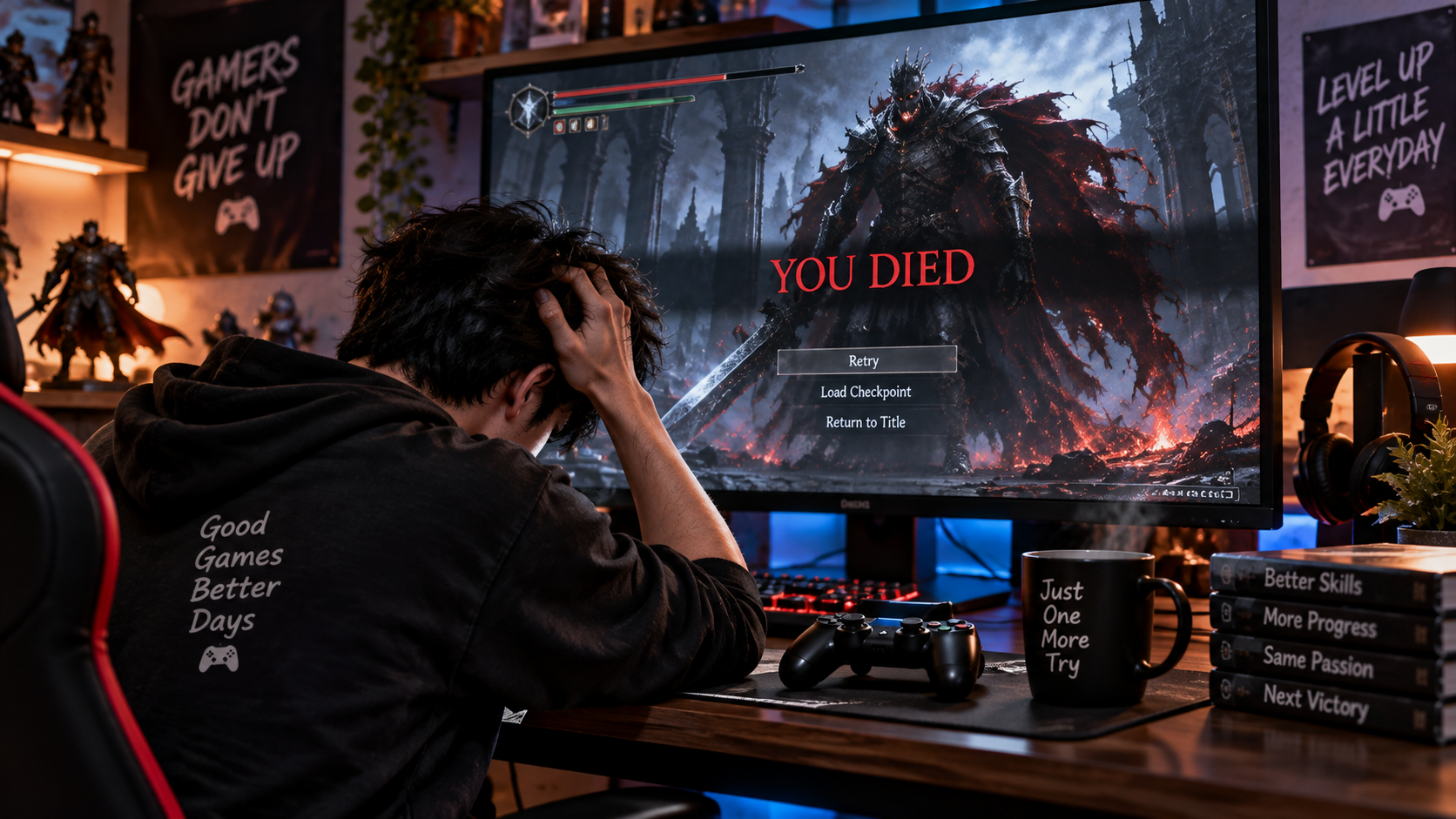
Boss health:
5%.
Your health:
basically a suggestion.
One more clean combo.
You can do this.
Boss attacks.
You dodge.
Attack.
Dodge again.
Then—
dead.
Fine.
That was close.
Next attempt?
Dead at 40%.
Again.
Dead at 60%.
Again.
You somehow get hit by an attack you’ve successfully avoided fifteen times.
Now you’re leaning toward the screen.
Grip tighter.
Jaw tighter.
Your strategy has evolved into:
attack everything immediately and become personally offended when it doesn’t work.
An hour ago, the boss looked difficult.
Now?
The boss appears to have insulted your entire family.
This is where difficult games become interesting.
Sometimes the enemy hasn’t become harder.
You’re simply playing worse.
Learning how to beat a difficult boss in games isn’t always about faster reactions or better equipment. Often, progress comes from understanding what repeated failure is doing to your decisions.
Your First Attempts Are Usually Information Gathering
New boss.
You enter the arena.
No idea what’s happening.
Huge attack.
Dead.
Attempt two?
Now you know about the huge attack.
Then the boss introduces:
another attack.
Excellent.
Dead again.
This isn’t necessarily failure.
You’re collecting information.
Difficult Bosses Are Often Pattern Recognition Problems
Many challenging encounters become easier once you recognize:
attack animations,
timing,
range,
safe positions,
phase transitions,
and punish windows.
The first attempt feels chaotic because everything is unfamiliar.
Later attempts become more predictable.
At least theoretically.
The Boss Isn’t Random Just Because You Don’t Understand It Yet
Player:
“This attack is completely random!”
Maybe.
But sometimes what looks random actually depends on:
your position,
distance,
previous action,
boss phase,
or another trigger.
Before assuming an encounter is unpredictable, observe what happens before each attack.
Stop Watching Only Your Character
This is a common problem.
You’re staring at:
your health,
your stamina,
your cooldowns,
your character.
Meanwhile the boss is preparing an attack approximately the size of a building.
Learn to watch enemy animations.
Animation Tells You What Happens Next
Boss raises weapon.
Pause.
Swing.
Once you recognize the sequence, the attack becomes easier to anticipate.
You’re no longer reacting only to the hit.
You’re reacting to the warning.
That’s a major difference.
Reaction Speed Isn’t Always the Real Skill
Players sometimes say:
“My reactions aren’t fast enough.”
But anticipation can reduce the need for extremely fast reactions.
If you know:
what attack is coming,
when it arrives,
and where it lands,
you can prepare before the dangerous moment.
Knowledge creates time.
Learn the Wind-Up
Most readable attacks have some form of preparation.
It may be:
movement,
sound,
glow,
stance,
camera cue,
or animation.
Identify it.
Then connect:
cue → attack → response.
Eventually this becomes automatic.
Audio Cues Matter More Than You Think
Some games communicate attacks through sound.
Boss screams.
Weapon makes a specific noise.
Character says a line.
Ability charges.
If you’re playing with audio extremely low while blasting unrelated music?
You may be removing useful information.
Don’t Dodge the Animation—Dodge the Attack
Boss raises sword.
You panic.
Dodge immediately.
Boss pauses.
Then swings.
You finish the dodge.
Sword arrives.
Dead.
Delayed attacks are designed to punish automatic reactions.
Wait for the actual timing.
Panic Rolling Is a Real Lifestyle
Hit once.
Roll.
Roll.
Roll.
Roll.
No stamina.
Boss:
thank you.
Repeated defensive actions can feel safe because you’re doing something.
But uncontrolled dodging often creates new vulnerabilities.
One Good Dodge Beats Four Bad Ones
Learn when the dangerous part of an attack occurs.
Then use the defensive action deliberately.
This can preserve:
stamina,
position,
resources,
and opportunities to counterattack.
Stop Pressing Buttons Because You’re Nervous
Difficult encounters create urgency.
Urgency creates input spam.
Attack.
Attack.
Dodge.
Attack.
Heal.
Dodge.
Maybe jump?
Why?
No idea.
Calm inputs are usually more reliable than panic inputs.
Button Mashing Can Hide What Went Wrong
If you’re pressing everything constantly, it’s harder to understand which decision caused the failure.
Cleaner play provides clearer feedback.
You can actually identify:
“I attacked one extra time.”
That’s useful.
Greed Kills More Boss Attempts Than Difficulty
Boss vulnerable.
You attack.
Good.
Attack again.
Good.
One more?
Probably not.
But look at that health bar.
One more.
Boss recovers.
You die.
Classic.
The Extra Hit Is Usually the Expensive One
Many difficult games teach the same lesson:
take the damage you safely have, not the damage you emotionally want.
If the punish window allows two attacks?
Do two.
Not:
two plus one hopeful bonus attack.
Low Boss Health Makes Players Worse
Boss at 10%.
Your brain:
WE’RE ALMOST THERE.
Suddenly every disciplined habit disappears.
You chase.
Overextend.
Ignore stamina.
Use risky attacks.
Die.
The final 10% can feel harder because your decision-making changes.
Pretend the Health Bar Doesn’t Exist
When the boss is nearly defeated, continue playing as if it still has:
50% health.
Same rhythm.
Same patience.
Same punish windows.
Don’t suddenly invent a new strategy because victory is visible.
Your Own Health Bar Can Cause the Opposite Problem
You’re nearly dead.
Now you’re terrified.
You stop attacking.
Run around.
Wait desperately for a healing opportunity.
Boss pressures you.
Dead.
Low health changes behavior too.
Healing Is Often a Tactical Action
In many games, healing isn’t free.
It has:
animation time,
positioning requirements,
resource costs,
or recovery frames.
Don’t heal simply because you’re hurt.
Heal when the encounter gives you a safe opportunity.
Sometimes Attacking Is Safer Than Healing
Boss finishes long recovery animation.
You have low health.
Instinct:
heal.
But perhaps the best choice is:
damage,
stagger,
or finish the phase.
The correct decision depends on the game.
The point is:
health alone doesn’t decide the action.
Position Creates Opportunities
Two players fight the same boss.
Player A stays directly underneath it.
Player B maintains medium distance.
Boss behavior changes.
Different attacks appear.
Positioning can influence the entire encounter.
Find the Range Where You Understand the Fight
Some bosses are easier:
close.
Others:
far.
Some punish medium range.
Experiment.
Don’t assume maximum distance automatically means maximum safety.
Running Away Can Trigger Worse Attacks
You create distance.
Boss:
excellent.
Launches enormous projectile.
Now you’re dodging attacks you never saw when staying close.
Sometimes the safest position is surprisingly near the enemy.
Camera Management Is Part of the Fight
Large boss.
Tiny arena.
Camera decides:
wall.
Fantastic.
If you can’t see the attack, avoiding it becomes much harder.
Pay attention to:
arena edges,
lock-on behavior,
and camera positioning.
Don’t Fight the Boss and the Wall
Backing away constantly?
Eventually:
wall.
Now movement options disappear.
Try to maintain awareness of the arena.
Reposition before you’re trapped.
Lock-On Isn’t Always Better
Target lock can make:
tracking,
attacking,
and camera control
easier.
But against very large or highly mobile enemies, it may sometimes create awkward camera behavior.
Depending on the game, unlocking temporarily can help.
Your Build May Be Making the Fight Harder
Skill matters.
But games with:
equipment,
stats,
abilities,
or builds
often provide multiple solutions.
Maybe you’re attempting the encounter with:
poor damage type,
low defensive resistance,
or abilities that don’t fit the boss.
Check What Your Equipment Actually Does
Players collect:
weapons,
armor,
charms,
rings,
mods,
perks,
attachments.
Then use the same setup forever.
Read descriptions.
Some items may dramatically improve specific encounters.
Upgrade Materials Exist to Be Used
Inventory:
37 upgrade materials.
Player:
“I might need these later.”
Final boss:
still saving them.
Use resources when they meaningfully improve your build.
Games frequently give progression materials because progression is part of the intended system.
Don’t Upgrade Everything
Opposite problem.
You find:
new sword.
Upgrade.
New axe.
Upgrade.
Interesting spear.
Upgrade.
Now your resources are spread across eight weapons.
Choose a few options that fit your playstyle before investing heavily.
Damage Type Can Matter
Boss appears armored.
Your weapon does one type of damage.
Another option may perform better.
Some games include:
elemental weaknesses,
armor resistances,
status effects,
or vulnerable body parts.
Learning the system can reduce difficulty dramatically.
But Don’t Turn Every Fight Into Homework
You don’t always need:
spreadsheet,
damage calculator,
and twelve browser tabs.
Try the encounter.
Observe.
Experiment.
Look deeper when you’re genuinely stuck.
Optimization should support fun.
Not replace it.
Consumables Are Not Museum Exhibits
Inventory:
fire bomb × 19.
Potion × 12.
Special buff × 7.
Player:
“I should save these.”
For what?
Your retirement?
Difficult encounters are exactly where useful consumables may belong.
The Fear of Wasting Items Can Waste More Time
You refuse to use a consumable because the attempt might fail.
Then fail twenty times without using it.
Sometimes spending resources is cheaper than spending another hour.
Learn Which Resources Are Renewable
Some consumables are:
easy to buy,
craftable,
or farmable.
Others are genuinely rare.
Understanding availability helps you decide what to use freely.
Your Strategy May Work—Just Not Consistently
You’ve reached the final phase three times.
Good sign.
That suggests your approach can work.
Now ask:
Where does consistency break?
Early damage?
Resource management?
One specific attack?
Identify the weakest part.
Don’t Redesign Everything After Every Death
Attempt one:
sword.
Death.
Attempt two:
magic.
Death.
Attempt three:
new armor.
Death.
Attempt four:
completely different build.
Now you’re learning nothing consistently.
Change one important variable at a time.
Consistency Makes Practice Useful
Same general setup.
Same approach.
Repeated attempts.
Now patterns become easier to compare.
You can identify what actually improves performance.
Change Strategy When the Pattern of Failure Is Clear
Consistency doesn’t mean stubbornness.
If you’re dying the same way repeatedly, adjust.
For example:
always getting hit after third attack?
Stop at two.
Always running out of stamina?
Use fewer actions.
Always trapped near wall?
Reposition earlier.
Failure should produce information.
“Try Harder” Is Terrible Analysis
You died.
Why?
“Need to play better.”
Okay.
How?
Useful analysis is specific.
“I dodge too early during the overhead attack.”
Now you have something to practice.
Name the Attack That’s Killing You
Boss has eight attacks.
Seven are manageable.
One destroys you.
Great.
You’ve found the problem.
Focus on learning that attack rather than treating the entire boss as impossible.
Give Attacks Your Own Names
You don’t need official terminology.
Call them:
big slam,
spin attack,
red explosion,
annoying laser,
the stupid grab.
Whatever helps you recognize the pattern.
The goal is mental organization.
Practice Survival Without Trying to Win
This technique can be surprisingly useful.
Enter the fight.
Don’t focus on damage.
Focus on:
dodging,
positioning,
and learning attacks.
How long can you survive?
Removing the pressure to win can make patterns easier to study.
One Attempt Can Be Pure Observation
Don’t attack immediately.
Watch.
What happens at close range?
What happens far away?
How long are recovery windows?
When does the boss change phases?
You’re spending one attempt to purchase information.
Cheap investment.
Phase Changes Reset the Learning Process
Phase one?
Easy now.
Boss reaches half health.
Cutscene.
Suddenly:
fire.
Flying.
Lasers.
Wonderful.
New phase means new patterns.
Treat it like a new encounter.
Don’t Waste Phase-One Resources
If you’ve mastered the first phase, aim to reach later phases with:
health,
healing,
ammo,
stamina,
or special resources
still available.
Early consistency gives you more opportunities to learn the difficult part.
The Real Goal May Be Reaching Phase Two Cleanly
Stop measuring progress only by:
boss health.
Progress could be:
reaching phase two without healing.
Avoiding the grab three times.
Consistently surviving the opening combo.
Small improvements accumulate.
Progress Is Often Invisible Before the Win
Attempt 1:
dead in 30 seconds.
Attempt 5:
dead in 50 seconds.
Attempt 10:
reach phase two.
Attempt 15:
boss at 20%.
Attempt 18:
terrible run.
Attempt 21:
win.
Skill improvement isn’t perfectly linear.
Bad attempts don’t erase learning.
Then Tilt Arrives
You almost win.
Next attempt goes badly.
Now you’re irritated.
You rush back.
Die quickly.
More irritated.
Rush back again.
Worse.
This is tilt.
Tilt Changes Decision-Making
When frustrated, players may:
attack more aggressively,
take unnecessary risks,
ignore patterns,
rush through earlier sections,
or blame every failure on the game.
The encounter hasn’t necessarily changed.
Your mental state has.
“One More Try” Has Destroyed Many Evenings
It’s 11:30 PM.
One more.
11:45.
One more.
12:10.
One more.
At 1:00 AM, you’re performing worse than you did at 10:45.
Persistence helps.
So does knowing when practice quality has collapsed.
Repetition Isn’t Always Productive Practice
Twenty focused attempts?
Useful.
Twenty angry attempts while repeating identical mistakes?
Less useful.
Practice quality matters.
Take a Break Before You Hate the Game
Stand up.
Drink water.
Walk around.
Do something else.
Return later.
This isn’t surrender.
It’s resetting attention.
Breaks Can Improve Performance
You’ve probably experienced this.
Boss destroys you for an hour.
You stop playing.
Return the next day.
Win within three attempts.
Why?
Your hands didn’t receive secret overnight upgrades.
Rest can reduce:
frustration,
fatigue,
and rigid habits.
Sleep Can Help Learning Settle
Motor skills and pattern learning can improve through practice followed by rest.
You don’t need to consciously think about the boss all night.
Sometimes stepping away is part of learning.
Fatigue Makes Simple Inputs Harder
You’re tired.
Reaction slower.
Attention narrower.
Timing inconsistent.
You begin missing things you easily handled earlier.
At that point, more attempts may reinforce sloppy play.
Recognize Your Personal Tilt Signals
Maybe you:
grip controller harder,
talk louder,
skip animations aggressively,
immediately sprint into arena,
or stop thinking between attempts.
These are useful signals.
They tell you:
practice quality is dropping.
Don’t Queue the Next Attempt Instantly
Death screen.
Instead of immediately pressing continue, ask:
Why did I die?
One sentence.
That’s enough.
“Got greedy after the slam.”
Next attempt:
fix that.
Separate Execution Errors From Strategy Errors
This distinction is extremely useful.
Execution error
You knew what to do.
You mistimed it.
Strategy error
What you were trying to do was wrong.
Different problem.
Different solution.
Execution Errors Need Practice
You know the parry timing.
But miss it.
Practice.
You understand the platforming sequence.
But mistime the jump.
Practice.
Mechanical consistency develops through repetition.
Strategy Errors Need Thinking
You keep blocking an attack that breaks guard.
More practice blocking won’t solve it.
You need another response.
Dodge.
Parry.
Move away.
Change equipment.
Different problem.
Don’t Grind Mechanics When the Strategy Is Wrong
Imagine trying 50 times with a tactic that fundamentally doesn’t work.
You’re not practicing victory.
You’re practicing failure.
Pause.
Reconsider.
Watch What Successful Attempts Have in Common
Maybe every good attempt happens when you:
stay close,
save ability for phase two,
avoid attacking after one specific move.
That’s evidence.
Build strategy around what repeatedly works.
Replays Can Reveal Bad Habits
If the game supports recording or you’ve captured gameplay, watching a failed attempt can be useful.
During the fight:
everything feels fast.
Watching afterward?
You may notice:
obvious mistakes.
“Why Did I Do That?”
Gameplay replay:
boss clearly preparing attack.
Your character:
starts slowest attack available.
You:
Why?
Excellent question.
Video can expose decisions you didn’t consciously notice.
Streamers Can Make Difficult Games Look Easy
You watch someone defeat the boss flawlessly.
“Why can’t I do that?”
Because you watched:
the successful run.
Not necessarily:
the hundreds of hours of experience behind it.
Skill compresses difficulty.
Don’t Copy High-Level Strategies Blindly
Expert player uses:
low health,
no armor,
extremely aggressive build.
Why?
Because they know the encounter perfectly.
You copy it.
Death.
A strategy optimized for experts may not be comfortable for learning.
Consistency Can Be Better Than Maximum Damage
Build A:
huge damage,
little room for mistakes.
Build B:
slightly lower damage,
better survivability.
Which is better?
For learning?
Maybe B.
The best theoretical setup isn’t always the best practical setup for you.
Defensive Options Buy Learning Time
More health.
Better resistance.
Shield.
Healing.
Defensive ability.
These can allow you to survive long enough to observe later phases.
Survival itself creates practice opportunities.
Eventually You Can Optimize
Once the fight is familiar, you can become more aggressive.
Shorter encounter.
More damage.
Riskier strategies.
But learning and speedrunning are different objectives.
Difficulty Settings Exist for a Reason
Some games offer:
easy,
normal,
hard,
or accessibility options.
Use the setting that produces the experience you want.
There is no gaming police arriving at your house to inspect your difficulty selection.
Lowering Difficulty Isn’t a Moral Failure
Games are entertainment.
Maybe you enjoy challenge.
Great.
Maybe you want story.
Also great.
Maybe you have limited time.
Fine.
The appropriate difficulty is the one that supports your reason for playing.
But Challenge Can Be Part of the Reward
For players who enjoy difficult encounters, repeated failure can make victory more satisfying.
The boss becomes:
a problem to understand.
Not merely an obstacle.
The eventual win feels earned because you remember the learning process.
Accessibility Options Can Preserve Challenge Differently
Modern games may offer options affecting:
timing,
damage,
visual cues,
controls,
or other mechanics.
These can allow more players to engage with the experience.
Accessibility doesn’t necessarily mean eliminating all challenge.
It can change where the challenge occurs.
Controls Should Feel Comfortable
You’re missing inputs constantly.
Before blaming yourself, check:
button layout,
sensitivity,
dead zones,
keybinds,
camera speed,
and accessibility settings.
Poor control configuration can create unnecessary difficulty.
PC Players Should Check Performance Too
Boss attack requires precise timing.
Game stutters.
Not ideal.
Frame-rate instability can affect input feel and visual consistency.
If performance is poor, adjust appropriate settings before deciding your reactions are terrible.
Stable Performance Can Matter More Than Pretty Graphics
Beautiful shadows.
Ultra effects.
Cinematic reflections.
Frame rate:
struggling.
For timing-sensitive gameplay, stable performance may provide a better experience than maximum visual settings.
Input Latency Matters in Fast Games
Press button.
Action feels delayed.
Possible causes vary across:
hardware,
display settings,
game settings,
and performance.
You don’t need to obsess over milliseconds for every game, but noticeable latency can make precise mechanics harder.
Controller Problems Can Look Like Skill Problems
Stick drift.
Sticky button.
Bad trigger.
Intermittent connection.
Before spending three hours questioning your gaming ability, confirm your equipment works properly.
Difficulty Can Come From Information Overload
Boss fight UI:
health.
Stamina.
Cooldowns.
Status effects.
Minimap.
Boss health.
Adds.
Projectiles.
Your brain:
please stop.
Learning what deserves attention is part of mastery.
You Don’t Need to Watch Everything Equally
Prioritize critical information.
For example:
enemy attack cues,
your essential resource,
and dangerous environmental mechanics.
As familiarity grows, some monitoring becomes automatic.
Tunnel Vision Is the Opposite Problem
Boss at 5%.
You stare at health bar.
Meanwhile:
floor is glowing red.
Probably relevant.
Maintain awareness of the arena.
Adds Can Be More Dangerous Than the Boss
Main enemy?
Manageable.
Three smaller enemies?
Chaos.
Sometimes the correct priority is eliminating secondary threats before returning to the boss.
Damage isn’t always the first objective.
Environmental Mechanics Need Respect
Fire floor.
Falling rocks.
Moving platforms.
Poison zones.
Boss is only part of the encounter.
Learn the arena as another enemy.
Safe Zones Can Become Part of Your Route
Where can you heal?
Where can you avoid the large attack?
Where should you stand during phase transition?
Once you know these locations, movement becomes more deliberate.
Resource Management Begins Before the Boss
Some games make you travel through enemies before reaching the encounter.
Arrive with:
half health,
no potions,
low ammo.
Now boss becomes harder.
Learn how to reach the arena efficiently.
Sometimes You Should Run Past Everything
If the game allows it and fighting every enemy provides no useful benefit, repeated runbacks may not require clearing the entire area.
Your goal is practicing the boss.
Save:
time,
health,
and patience.
Long Runbacks Increase Frustration
Death.
Walk two minutes.
Boss.
Death.
Walk two minutes.
Eventually, frustration may come more from the commute than the encounter.
Use checkpoints or shortcuts the game provides.
Always Look for Shortcuts
Elevator.
Door.
Ladder.
Checkpoint.
You missed it.
Now you’ve completed the same five-minute route fifteen times.
Explore.
Developers often provide shortcuts around repeated sections.
Boss Difficulty Is Sometimes a Progression Signal
Enemy feels almost impossible.
Maybe the game is saying:
go somewhere else.
Level up.
Find equipment.
Learn another mechanic.
Return later.
Open-world games especially may allow flexible progression.
“I Found It, Therefore I Must Beat It Now” Is Optional
You encounter powerful enemy early.
Game allows you to leave.
Player:
Absolutely not.
Three hours later:
still there.
You can come back.
Exploration is sometimes part of the intended solution.
Leveling Can Reduce Mechanical Pressure
More health.
More damage.
Better abilities.
Fight becomes more forgiving.
Using progression systems isn’t cheating.
It’s playing the game.
But Overleveling Can Change the Experience
If challenge is what you enjoy, becoming dramatically stronger may remove some of it.
Again:
choose the experience you want.
There isn’t one correct way to enjoy a single-player game.
Multiplayer Help Is Also a Tool
Some games allow:
co-op,
summons,
companions,
or other assistance.
Use them if you enjoy them.
A boss defeated with a friend is still a boss defeated.
Cooperative Play Changes the Encounter
Boss attention divided.
More damage sources.
Different positioning.
Sometimes additional health scaling.
Co-op isn’t simply “easy mode.”
It can create a different tactical fight.
Communication Makes Co-Op Better
Two players attack independently?
Chaos.
One draws attention.
Another heals or damages.
Better.
Even simple coordination can improve difficult encounters.
Don’t Blame Teammates for Everything
Multiplayer boss fails.
Immediate conclusion:
team bad.
Maybe.
But ask:
What could you control?
Position?
Timing?
Target priority?
Communication?
Focusing on controllable decisions produces more improvement.
Sometimes the Boss Is Actually Badly Designed
Yes.
Not every difficult encounter is brilliant.
A fight can suffer from:
poor camera behavior,
unclear telegraphs,
excessive repetition,
technical issues,
or mechanics that simply aren’t enjoyable.
Difficulty alone doesn’t automatically equal quality.
Frustration and Challenge Are Different
Challenge says:
“I understand what I need to improve.”
Frustration says:
“I don’t understand what the game wants from me.”
Great difficult games usually provide enough information for players to learn.
Fairness Often Comes From Readability
A powerful attack can feel fair if:
you can recognize it,
understand the response,
and improve through practice.
A weaker attack can feel unfair if it appears inconsistent or unreadable.
Clarity matters.
Good Difficulty Teaches
Early enemy introduces:
dodge timing.
Later enemy combines it with:
positioning.
Boss tests both.
Difficulty becomes satisfying when previous lessons become useful.
Difficulty Spikes Can Reveal Missing Fundamentals
You’ve survived using one bad habit.
Then a boss punishes it repeatedly.
Maybe the boss isn’t an isolated problem.
It’s exposing something you’ve avoided learning.
The Boss May Be Your Teacher
Can’t manage stamina?
Boss punishes exhaustion.
Always attack greedily?
Boss has fast counters.
Ignore positioning?
Boss traps you.
Good encounters often test fundamental systems.
Ask What the Game Has Been Teaching You
Before searching for a secret trick, think about earlier areas.
Did the game introduce:
parrying,
elemental effects,
movement abilities,
environmental tools,
or status mechanics?
The boss may expect you to use them.
Tutorials Are Easy to Forget
Tutorial:
“Hold this button to perform special defensive move.”
You:
understood.
Eight hours later?
Never used it once.
Boss arrives.
Maybe now is the moment.
Read Your Ability Descriptions Again
You unlocked abilities gradually.
Some were ignored.
Now one may solve a specific problem.
Revisit your toolkit when stuck.
Don’t Assume Your Favorite Move Is Always Correct
One combo carried you through normal enemies.
Boss interrupts it.
Now you need adaptation.
Mastery isn’t using one powerful technique everywhere.
It’s knowing when each tool fits.
Change One Thing Per Attempt
If you’re stuck, try a controlled experiment.
Attempt 1:
focus on shorter attack combos.
Attempt 2:
maintain closer distance.
Attempt 3:
save special ability for phase two.
Now you can compare.
Keep the Changes Simple
You don’t need a laboratory notebook.
Just mentally track:
What am I testing this attempt?
That alone makes repeated failures more productive.
Set a Learning Goal
Instead of:
“I must win this attempt.”
Try:
“I will successfully dodge the grab three times.”
Now even a losing attempt can succeed at its learning objective.
Pressure drops.
Skill improves.
Celebrate Micro-Progress
Yesterday:
grab kills you every time.
Today:
you avoid it consistently.
Boss still wins.
But you’ve removed one problem.
That’s progress.
Then Stack the Skills
Learn:
slam.
Then grab.
Then phase transition.
Then final combo.
Eventually the boss stops feeling like one giant impossible problem.
It becomes several smaller solved problems.
Mastery Makes Chaos Look Slow
First attempt:
WHAT IS HAPPENING?
Later:
slam.
Dodge.
Pause.
Two attacks.
Back away.
Grab incoming.
Move.
Same encounter.
Your perception changed.
This Is Why Experienced Players Look Calm
They aren’t necessarily reacting faster to everything.
They recognize more things earlier.
Patterns reduce uncertainty.
Uncertainty is what makes the first attempts feel overwhelming.
Stop Measuring Skill Only by Death Count
Died 30 times?
So what?
If attempt 30 is significantly better than attempt one, learning happened.
Death count alone doesn’t tell the story.
Some Players Learn Faster Through Failure
A death can provide immediate feedback.
That strategy didn’t work.
That timing was wrong.
That position was dangerous.
Games allow rapid experimentation with relatively low real-world consequences.
That’s part of their appeal.
Failure Is Cheap Information
In many games:
die.
Respawn.
Try again.
That’s an incredibly forgiving learning environment.
Use it.
But Don’t Repeat Meaningless Failure Forever
There is a difference between:
experimentation
and
headbutting the same wall.
If you’re no longer learning?
Change something.
Or take a break.
A Simple Five-Step Boss Method
Stuck?
Try this.
Step 1: Observe
Spend an attempt learning attacks.
Don’t chase damage.
Step 2: Identify the Main Problem
Which attack or phase causes most deaths?
Focus there.
Step 3: Simplify
Use safe attacks.
Reduce unnecessary inputs.
Stay patient.
Step 4: Adjust One Variable
Positioning?
Equipment?
Timing?
Resource use?
Change one meaningful thing.
Step 5: Stop When Practice Quality Drops
If you’re becoming increasingly angry and sloppy, leave.
Return later.
The boss isn’t going anywhere.
The Funny Part?
Eventually you’ll win.
Maybe barely.
One health remaining.
No healing.
Hands shaking.
Victory screen appears.
You celebrate.
Then six months later, you replay the game.
Same boss.
You defeat it in three attempts.
And suddenly you wonder:
“Why did I ever think this was impossible?”
Because it isn’t the same fight anymore.
You brought experience back with you.
FAQ
Why do I start playing worse after repeatedly fighting the same boss?
Fatigue, frustration and repeated unsuccessful attempts can affect attention and decision-making. Players may begin rushing, over-attacking or repeating habits they had previously avoided.
How should I practice a difficult boss fight?
Focus on recognizing attack patterns, identifying the specific situations causing deaths and making deliberate adjustments. Some attempts can be used primarily for observation rather than trying to win immediately.
Should I change my build when I’m stuck on a boss?
It can help if the game includes equipment, weaknesses or abilities relevant to the encounter. However, changing everything after every attempt can make it difficult to determine what is actually improving performance.
Is taking a break useful when stuck in a game?
Yes. A break can reduce frustration and mental fatigue. Returning with better concentration may make previously familiar patterns easier to execute against.
Why do I always die when the boss has very little health left?
Players often become more aggressive when victory appears close. This can lead to overextending, ignoring established attack windows or taking unnecessary risks.
Should I lower the difficulty if a boss is too hard?
If the game offers difficulty or accessibility settings, use the options that create the experience you want. Players have different reasons for playing, and there is no universal requirement to use a particular difficulty.
Is watching a boss guide cheating?
No. Some players prefer discovering encounters independently, while others enjoy learning through guides or videos. Choose whichever approach makes the game more enjoyable for you.
Conclusion
Attempt seventeen.
Boss:
5% health.
You:
dead.
Attempt eighteen.
Boss:
60% health.
You:
dead again.
Now you’re convinced the game secretly changed the difficulty.
Probably not.
The more likely explanation?
You’re tired.
You’re frustrated.
You’re rushing.
And somewhere between attempt ten and attempt eighteen, you stopped studying the fight and started arguing with it.
That’s the moment to change approach.
Watch the boss.
Learn the cues.
Stop taking the extra hit.
Identify the attack that keeps killing you.
Use the tools the game gives you.
Change one thing at a time.
And when your hands are still playing but your brain has clearly gone home?
Stop.
Because difficult games aren’t usually beaten by producing the largest possible number of attempts.
They’re beaten when each attempt teaches you enough that eventually the boss no longer looks unpredictable.
The attacks are the same.
The arena is the same.
The boss is the same.
The player isn’t.