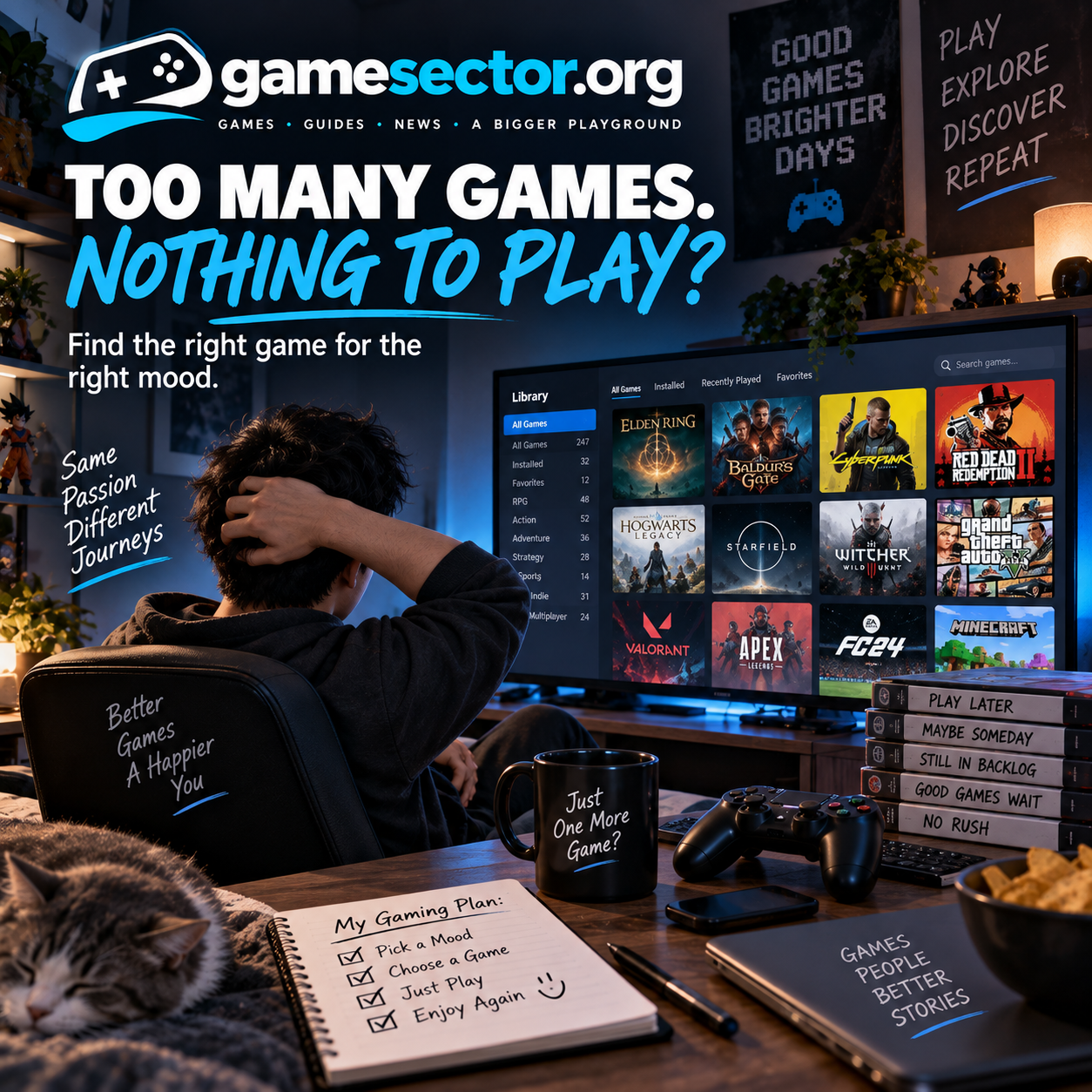
You open your game library.
Scroll.
Scroll again.
There are RPGs you bought during a sale.
Three multiplayer games your friends convinced you to install.
An indie game with amazing reviews.
A massive open-world title you started six months ago.
And at least ten games you have never launched.
Hundreds of options.
So what do you play?
Nothing.
You close the library and somehow end up watching gaming videos instead.
Sound familiar?
Modern gamers have access to more games than ever, but having more choices does not always make choosing easier.
Learning how to choose what game to play is less about finding the objectively “best” game and more about matching a game to what you actually want right now.
Your Backlog Is Not a To-Do List
This is probably the first rule.
You bought the game.
You did not sign a contract promising to finish it.
Yet gaming backlogs often begin feeling like work.
“Need to finish this.”
“Still have 40 hours left.”
“Can’t start another game until this one is done.”
Congratulations.
Your entertainment now has deadlines.
A backlog should represent options, not obligations.
Stop Choosing Based Only on Reviews
Game A:
95% positive.
Game B:
82% positive.
Game A must be better for you, right?
Not necessarily.
Reviews can help identify quality, technical problems, and common strengths or weaknesses.
But they cannot know your current mood.
The world’s greatest 80-hour RPG is still a terrible recommendation when you only want to play something for 30 minutes before bed.
Ask One Question First
Before browsing your entire library, ask:
“What kind of experience do I want tonight?”
Not:
“What is the highest-rated game I own?”
Maybe you want:
competition,
exploration,
story,
relaxation,
progression,
strategy,
or complete chaos with friends.
Once you know the experience, the list becomes much smaller.
Match the Game to Your Available Time
You have 45 minutes.
Maybe tonight is not the night to begin a gigantic RPG with:
a cinematic introduction,
character creation,
tutorials,
dialogue,
and seventeen menus.
A shorter session might be better suited to:
a racing game,
a roguelike,
a fighting game,
a few multiplayer matches,
or a familiar game you can immediately enter.
Longer free evening?
Now the RPG makes more sense.
Some Games Have High “Startup Friction”
You know the feeling.
You want to return to a game you stopped playing two months ago.
You launch it.
Immediately:
“Wait… what was I doing?”
“What does this button do?”
“Who is this character?”
“Why do I have 47 unfinished quests?”
Some games are easy to return to.
Others require mental reloading.
That matters when choosing what to play.
Your 80-Hour Save File Is Not a Prison
You spent 30 hours on a game.
Then stopped enjoying it.
Now you feel obligated to finish because:
“I’ve already invested 30 hours.”
But those 30 hours are already gone whether you continue or not.
The useful question is:
Do I want to spend another 30?
If the answer is no, stopping is completely reasonable.
It Is Okay to Drop a Good Game
This is strangely difficult for gamers.
A game can be:
well designed,
beautiful,
critically acclaimed,
and loved by millions…
while still not being for you.
Or maybe it is for you, just not right now.
You do not need to prove a game is bad before you’re allowed to stop playing it.
Sometimes the Genre Is the Problem
Maybe you have spent the last two months playing:
open-world RPG,
open-world action game,
open-world survival game,
another open-world RPG.
Then you buy a highly rated new open-world game.
Ten hours later:
“This feels boring.”
Maybe the game is not boring.
Maybe you are tired of open worlds.
Genre fatigue is real enough as an experience even if the games themselves are very different.
Switching genres can refresh gaming surprisingly quickly.
Try the Opposite of Your Last Game
Finished something huge?
Play something short.
Finished a difficult competitive game?
Try something relaxed.
Finished a dialogue-heavy RPG?
Try an action game.
Spent weeks playing solo?
Play something cooperative.
Contrast can make games feel fresh again.
Multiplayer Games Create a Different Problem
Your friends are online.
They are playing the same game they always play.
You join.
Again.
Two hours later, you realize you never touched the single-player game you planned to start.
Multiplayer games have extremely low decision friction when friends are involved.
Someone sends:
“You on?”
Decision made.
That is not necessarily bad.
Gaming is social entertainment too.
But it can quietly consume all your gaming time.
Separate “Comfort Games” From “Games I Want to Experience”
A comfort game is something you can launch almost automatically.
Maybe:
a competitive shooter,
football game,
MOBA,
sandbox,
racing game,
or familiar multiplayer title.
Then you have games you genuinely want to experience:
a new RPG,
story game,
indie title,
or strategy game.
If comfort games always win by default, deliberately reserve occasional sessions for the second category.
Do Not Install Everything
A library containing 300 games creates one problem.
A screen containing 300 installed games creates an even bigger one.
Try keeping a smaller active rotation installed.
For example:
1 main game
Your current longer experience.
1 multiplayer game
For friends or competitive sessions.
1 short-session game
For quick play.
1 wildcard
Something completely different.
Suddenly choosing becomes easier.
The “Main Game” Method Works Surprisingly Well
Choose one game as your primary longer-term title.
You do not have to play it every day.
You can still play other things.
But when you have a decent block of free time and no specific preference, this becomes your default.
It reduces the nightly:
“What should I play?”
problem.
Be Careful With Sales
The game normally costs $50.
Today it costs $12.
You buy it.
Great deal.
Except you never play it.
How much did you save?
Not $38.
You spent $12.
Game sales are useful when they reduce the price of something you actually want.
They become backlog factories when the discount itself becomes the reason to buy.
“I Might Play It Someday” Is Expensive
One game?
Fine.
Twenty?
Now you have built a museum.
Before buying, ask:
Would I install and play this within the next few weeks?
If not, there will probably be another sale.
Your library does not need emergency supplies.
Subscription Libraries Make Choice Even Harder
Game subscription services can provide enormous value.
They also create a Netflix-style problem.
Browse.
Add to list.
Browse more.
Watch trailer.
Check another game.
Forty minutes later, nothing has been played.
When the catalog is huge, limit your shortlist before sitting down to play.
Pick three candidates.
Choose from those.
Ignore everything else for the evening.
Stop Researching After You Already Bought the Game
You buy a game.
Then watch:
reviews,
beginner guides,
build videos,
tier lists,
“10 Things I Wish I Knew” videos,
and optimization guides.
By the time you launch it, you already know half the systems.
Sometimes research helps.
But sometimes discovering how a game works is part of playing it.
Give yourself permission to be a beginner.
You Do Not Need the Perfect Build
This particularly affects RPG and strategy players.
You receive your first skill point.
Immediately:
Google.
“What is the BEST build?”
Suddenly your playthrough belongs to someone else’s spreadsheet.
Unless the game heavily punishes experimentation, try making some decisions yourself.
A slightly imperfect build can create a more personal experience.
Difficulty Settings Are Tools
You bought the game to enjoy it.
If a difficulty setting makes the experience:
boring,
frustrating,
or exhausting,
change it when the game allows.
There is no universal correct difficulty.
Some players enjoy mastering brutal combat.
Others want the story.
Others want something between the two.
Choose what creates the experience you want.
Finishing Games Is Not the Goal of Gaming
Completion percentages can become strangely powerful.
62%.
78%.
91%.
Almost there.
But finishing more games does not automatically mean enjoying gaming more.
A three-hour unfinished game you loved can be more valuable than a 70-hour game you forced yourself to complete.
Entertainment is not productivity.
Track Favorites, Not Just Finished Games
Instead of maintaining only a backlog, create a small list:
Games I genuinely want to play next.
Keep it short.
Maybe five titles.
When you finish or drop your current game, choose from those five.
Do not reopen the entire library.
This prevents hundreds of options from competing for attention.
Use a Three-Session Rule
Not sure about a game?
Give it a fair chance.
For some titles, one session is enough.
Others take longer to reveal their systems.
A simple personal rule could be:
play two or three proper sessions.
Then decide:
Continue
Pause
or
Drop
No guilt.
No endless “maybe later” hovering.
Paused and Dropped Are Different
Paused:
“I like this, but I’m not in the mood right now.”
Dropped:
“I don’t want to continue.”
Making that distinction helps clean up the mental backlog.
You can return to paused games later.
Dropped games can leave the list.
Replay Games Without Feeling Guilty
You have 50 untouched games.
Yet you want to replay something you’ve already finished.
Do it.
The purpose of owning games is not to maximize the percentage of your library you have completed.
Sometimes replaying a favorite game is exactly the experience you want.
That is enough.
Stop Comparing Your Progress With Streamers
A creator finishes a new game in three days.
You are still in Chapter 2 after two weeks.
That is normal.
Gaming may be their:
job,
main hobby,
content schedule,
or primary source of entertainment.
Your available time may be completely different.
There is no deadline.
Different Life Stages Create Different Gaming Habits
At one point, you might have had entire weekends available.
Later:
work,
study,
relationships,
family,
and responsibilities
change how much uninterrupted time you have.
Your taste in games may change with it.
Maybe you no longer want 100-hour adventures every month.
That does not mean you stopped being a gamer.
Your gaming simply adapted to your life.
A Simple System for Choosing Tonight’s Game
When you cannot decide, use this:
Step 1: How much time do I have?
Under an hour?
One to three hours?
Whole evening?
Step 2: What energy level do I have?
Tired?
Focused?
Competitive?
Relaxed?
Step 3: Do I want solo or social?
This immediately removes many options.
Step 4: What experience sounds fun?
Story?
Action?
Strategy?
Exploration?
Competition?
Step 5: Choose from three games maximum.
Not thirty.
Three.
Then launch one.
Example
You have:
90 minutes.
You’re tired.
You don’t want voice chat.
You want something relaxing.
That eliminates:
competitive ranked game,
complex strategy game,
huge story section requiring concentration.
Maybe tonight becomes:
a cozy game,
racing game,
sandbox,
casual adventure,
or something familiar.
Tomorrow might produce a completely different answer.
That is the point.
Your Backlog Should Serve You
Games are unusually demanding entertainment.
A movie may ask for two hours.
A game can ask for:
20,
50,
100,
or 300.
You cannot realistically experience everything.
And you do not need to.
The goal is not to defeat the backlog.
The backlog is infinite.
New games will keep releasing.
Old games will keep going on sale.
Subscription catalogs will keep expanding.
You win by choosing experiences you actually enjoy.
FAQ
Why do I have so many games but nothing to play?
Too many choices can make decisions harder, especially when your library contains games requiring different amounts of time, attention, and commitment.
Should I finish one game before starting another?
Not necessarily. Some players enjoy focusing on one title, while others prefer rotating between a few different games. Use whichever approach keeps gaming enjoyable.
Is it okay to stop playing a game I paid for?
Yes. Money already spent does not require you to spend additional hours on something you no longer enjoy.
How many games should I play at once?
There is no perfect number, but keeping a small active rotation can reduce choice overload. One main game plus a few alternatives works well for many players.
Should I buy games just because they are heavily discounted?
A discount is valuable only if you actually want the game. If it will sit untouched indefinitely, the low price can still become unnecessary spending.
How can I reduce my gaming backlog?
Instead of trying to finish everything, create a short priority list, uninstall games you are not currently interested in, and freely drop titles you no longer enjoy.
Conclusion
You probably do have something to play.
Actually, you probably have too many things to play.
That is the problem.
So stop treating your library like a checklist that must eventually reach zero.
Choose based on:
your time, your mood, your energy, and the experience you want today.
Play the RPG when you want an adventure.
Play multiplayer when you want your friends.
Replay an old favorite when nothing new sounds interesting.
And drop the game that has felt like homework for the last twelve hours.
Your backlog will survive.
It always does.