
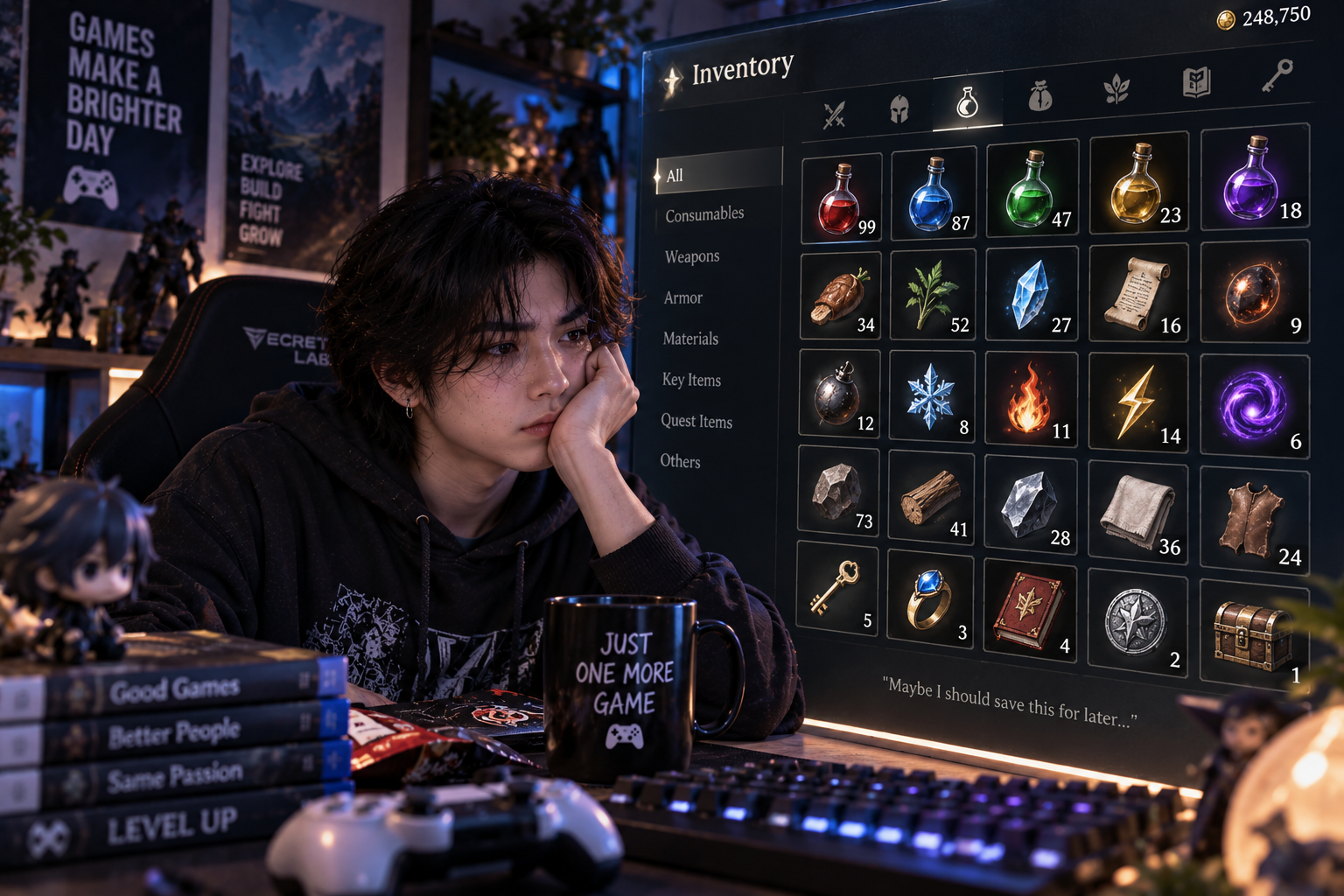
The boss fight is going badly.
Your health is low. There are healing potions sitting in your inventory. You have more than enough of them, and this is exactly the situation they were designed for.
Still, a thought appears.
Maybe I should save them for later.
So you restart the fight instead.
Eventually, the credits roll and you discover that half of those potions, bombs, scrolls, elixirs, temporary buffs, and rare crafting materials survived the entire adventure untouched.
If this sounds familiar, you are far from alone. Understanding why players hoard items in games reveals something interesting about the relationship between game design, uncertainty, scarcity, and the way players make decisions when they do not know what is coming next.
The Real Problem Is Not the Item—It Is the Unknown Future
Imagine a game tells you exactly what will happen.
There are three fights remaining. You have six healing potions, and no additional items will ever be needed after the third fight.
Using a potion becomes an easy decision.
Most games do not provide that certainty.
You do not know whether the next room contains another checkpoint, a merchant, a difficult boss, or twenty minutes of combat.
That uncertainty gives every consumable an invisible second value.
A potion is worth whatever it can do right now, but it is also worth whatever it might do later.
The second value is what makes players hesitate.
Rare Items Feel More Valuable Than Their Actual Effect
Games often communicate rarity very effectively.
A common potion might be easy to use because you know another one will appear soon. A glowing legendary elixir with a unique name feels different.
Even if the game clearly explains what it does, the rarity creates psychological weight.
Players start thinking there must be an especially important moment where the item belongs.
The problem is that the game rarely announces that moment.
So the player waits.
Then waits again.
Eventually, the item becomes too precious to use precisely because it has remained unused for so long.
“I Might Need It Later” Is Difficult to Disprove
Suppose you use your strongest temporary buff during a difficult encounter.
Five minutes later, an even harder boss appears.
Now it is easy to think you made a mistake.
But consider the opposite situation.
You refuse to use the buff, struggle through the first encounter, and later discover another copy before the boss.
The decision to save it now seems unnecessary.
Players have incomplete information, so resource decisions are made using predictions rather than certainty.
When a game repeatedly surprises players with difficulty spikes, saving items can begin to feel safer than using them.
Games Can Accidentally Train Players to Hoard
Early-game scarcity matters.
If the first few hours teach players that healing items are difficult to replace, they may continue treating those items as scarce even after the economy changes.
Perhaps the player eventually has plenty of money.
Maybe merchants now sell unlimited potions.
The original lesson can remain.
The game taught the player that resources disappear quickly, so the player developed conservative habits.
Once established, those habits may survive long after the reason for them disappears.
Limited Inventory Can Create the Opposite Behavior
Interestingly, inventory restrictions can sometimes encourage item usage.
If you can carry only five potions and already have five, finding another one creates a decision.
Use something or leave the new resource behind.
Suddenly, hoarding has a visible cost.
Games with effectively unlimited storage remove that pressure. The player can accumulate 10, 20, or 100 copies without sacrificing anything.
When saving has no immediate downside, “keep it for later” becomes extremely easy.
Consumables Compete With Repeatable Abilities
Suppose your character has a spell that regenerates after every fight.
You also have a bomb that disappears permanently when used.
Even if the bomb is stronger, many players naturally prefer the renewable ability.
Why?
Because one option has no long-term opportunity cost.
You can use the spell now and still have it later. The bomb forces a permanent decision.
This is why consumables can become neglected when a game gives players slightly weaker but infinitely reusable alternatives.
The renewable option feels economically safer.
Crafting Systems Can Make Hoarding Even Worse
Rare crafting materials introduce another layer of uncertainty.
You find a strange crystal.
The game tells you it can be used to craft equipment, but you have not unlocked every recipe yet.
Should you craft the sword available now?
Or save the crystal in case a better weapon becomes available later?
Without knowing the complete crafting tree, players may postpone the decision.
The same behavior appears with upgrade materials.
A player may continue using an underpowered weapon because spending resources on it feels dangerous when a potentially better weapon could appear soon.
The Better the Item, the Harder It Can Be to Use
This creates a strange contradiction.
Powerful consumables should make difficult encounters easier.
But because they are powerful, they often feel rare.
Because they feel rare, players save them.
The game’s strongest consumables can therefore become the items least likely to influence actual gameplay.
A powerful item that remains permanently inside the inventory has effectively provided zero combat value.
Its theoretical strength does not matter if the player never presses the button.
Difficulty Can Change the Equation
On easier difficulty settings, players may not need consumables often enough to build the habit of using them.
Basic attacks, healing abilities, or ordinary equipment already solve most encounters.
So consumables accumulate.
Higher difficulty can make those resources much more relevant.
Suddenly, resistance items, buffs, grenades, food, potions, or ammunition types can determine whether an encounter feels impossible or manageable.
The interesting part is that a player who learned to ignore consumables on normal difficulty may carry the same habits into harder modes.
Players Often Treat Failure as Cheaper Than Consumption
This sounds strange until you look at how many games handle death.
Suppose losing a boss fight costs thirty seconds.
Using a rare potion costs the potion forever.
From the player’s perspective, restarting can feel cheaper.
So they attempt the boss repeatedly without using resources.
This becomes especially common when checkpoints are generous.
If failure carries little cost, the player can preserve every consumable by simply trying again.
In that environment, item hoarding can actually be a rational response to the game’s systems.
Save Systems Influence Resource Behavior
Imagine two versions of the same dungeon.
In the first, dying sends you back forty minutes.
In the second, dying restarts you directly outside the boss room.
Would you use items the same way?
Probably not.
When failure threatens significant progress, consumables gain immediate value because they help protect time already invested.
Frequent checkpoints reduce that pressure.
The player knows another attempt is inexpensive, so using a rare item becomes less attractive.
Resource economy and save design are more connected than they initially appear.
Players Also Hoard Because They Forget What Items Do
Large inventories create another problem.
You collect dozens of items with different effects: poison resistance, fire resistance, temporary attack bonuses, stamina recovery, throwable damage, status cures, and more.
Eventually, opening the inventory feels like reading a spreadsheet.
Instead of learning every item, players return to familiar abilities.
Useful resources remain untouched because remembering when to use them requires too much mental effort.
An inventory full of options can paradoxically make players use fewer options.
Poor Interface Design Makes Consumables Feel Inconvenient
An item may be powerful but annoying to access.
If using it requires opening several menus, navigating categories, reading descriptions, and confirming the action, players are less likely to incorporate it into moment-to-moment gameplay.
Quick slots can change this dramatically.
Once a potion or grenade is available through a single button, it becomes part of the player’s combat vocabulary.
Good interface design does not merely make inventories prettier.
It can change which game mechanics players actually use.
Players Save Items for the “Perfect” Situation
There is another trap: optimization.
Maybe a potion restores 100 health.
You are missing only 40.
Using it now feels wasteful because 60 points of healing would be lost.
So you wait.
Later, you are missing 90 health, but now the fight seems manageable enough without it.
You wait again.
Players often search for a situation where the item’s entire value will be used efficiently.
That perfect moment may never arrive.
Hoarding Can Make the Game Harder Than Intended
Developers often balance encounters assuming players will use the tools available to them.
If you ignore bombs, buffs, elemental items, healing resources, and status cures, you are effectively playing with a restricted toolkit.
A difficult encounter may not require better reflexes.
It may require using the inventory.
This is especially common in RPGs and survival games where preparation is part of the intended challenge.
Sometimes the item you are saving for a difficult fight is meant for the difficult fight you are already in.
Resource Abundance Should Change Your Decisions
One useful habit is checking whether an item is genuinely scarce.
Can merchants sell more?
Do enemies drop it regularly?
Can it be crafted from common materials?
Are you already carrying twenty?
If replacement is easy, treating every use as a major sacrifice makes little sense.
Your strategy should change when the game’s economy changes.
An item that was precious during the first hour may be completely ordinary by hour twenty.
Create Your Own Minimum Stock
If using consumables makes you uncomfortable, you do not have to swing from extreme hoarding to using everything immediately.
Create a reserve.
For example, decide that you want to keep five healing items available.
If you have twelve, seven are effectively available for normal use.
This creates psychological safety while still allowing resources to participate in gameplay.
The exact number depends on the game.
The important part is separating “emergency reserve” from “items I am allowed to use.”
Use Items to Learn What They Actually Do
Players sometimes save an item because they do not fully understand its value.
The easiest solution is experimentation.
Use one in a normal encounter.
How much damage does it deal? How long does the buff last? How large is the effect? Does it stack with another ability?
Now you have information.
A consumable stops being a mysterious inventory icon and becomes a tactical option you understand.
Knowledge makes future resource decisions easier.
Boss Fights Are Usually a Good Time to Stop Saving Everything
You reach a major boss with thirty potions, several attack buffs, elemental resistance items, and powerful throwables.
This is probably not the moment to protect your inventory from the game.
The resources exist to create advantages.
Use what meaningfully helps.
If the game later provides an even harder encounter, you can solve that resource problem when you reach it.
Saving every tool for an imaginary future challenge can make the challenge directly in front of you unnecessarily frustrating.
Developers Can Reduce Hoarding Through Design
Games have several ways to encourage players to actually use consumables.
Carry limits are one option.
Reliable crafting is another.
Some games automatically replenish certain resources at checkpoints. Others make consumables inexpensive enough that experimentation does not feel punishing.
Clear descriptions also help.
When players understand how to replace an item and what it does, the uncertainty surrounding its use decreases.
A well-designed economy gives resources value without making players afraid to interact with them.
Not Every Hoarded Item Is a Problem
Of course, players are allowed to enjoy games however they want.
Collecting items can itself be satisfying.
Some players enjoy finishing an RPG with an absurdly full inventory. Others like maximizing currency or collecting every rare object.
There is nothing inherently wrong with that.
Hoarding becomes worth questioning when it works against your own enjoyment—when you repeatedly struggle through encounters while refusing to use tools specifically designed to make those encounters more interesting.
At that point, the inventory is no longer helping you.
You are protecting it.
Try Thinking of Consumables as Temporary Abilities
Instead of thinking, “If I use this, I lose one item,” try another framing.
“This item gives me an ability right now.”
A grenade becomes temporary area damage.
A resistance potion becomes temporary defense.
A healing item becomes additional survivability.
A crafting material becomes an equipment upgrade.
Resources exist to be converted into advantages.
Keeping them forever preserves their potential, but never receives their benefit.
The Credits Screen Reveals the Problem Perfectly
There is something funny about finishing a sixty-hour RPG and opening the inventory one final time.
Ninety-nine basic potions.
Twenty-seven stronger potions.
Six legendary elixirs.
Four rare bombs.
Enough crafting materials to equip a small army.
Every item was saved because it might become important later.
Then the game ends.
There is no later.
Conclusion
Understanding why players hoard items in games starts with uncertainty. Players rarely know how difficult the next encounter will be, how easily a resource can be replaced, or whether an even better use will appear later.
Game systems can reinforce that behavior through early scarcity, rare-item presentation, generous checkpoints, complicated inventories, and permanent consumables competing against renewable abilities.
But an unused resource has an overlooked cost.
It provides no benefit.
You do not need to waste every item the moment you find it. Keep sensible reserves, understand how resources are replenished, and save genuinely rare tools when there is a reason.
Just remember what happens when the boss has almost defeated you and there are 47 healing potions sitting untouched in your inventory.
Sometimes “later” is already happening.