
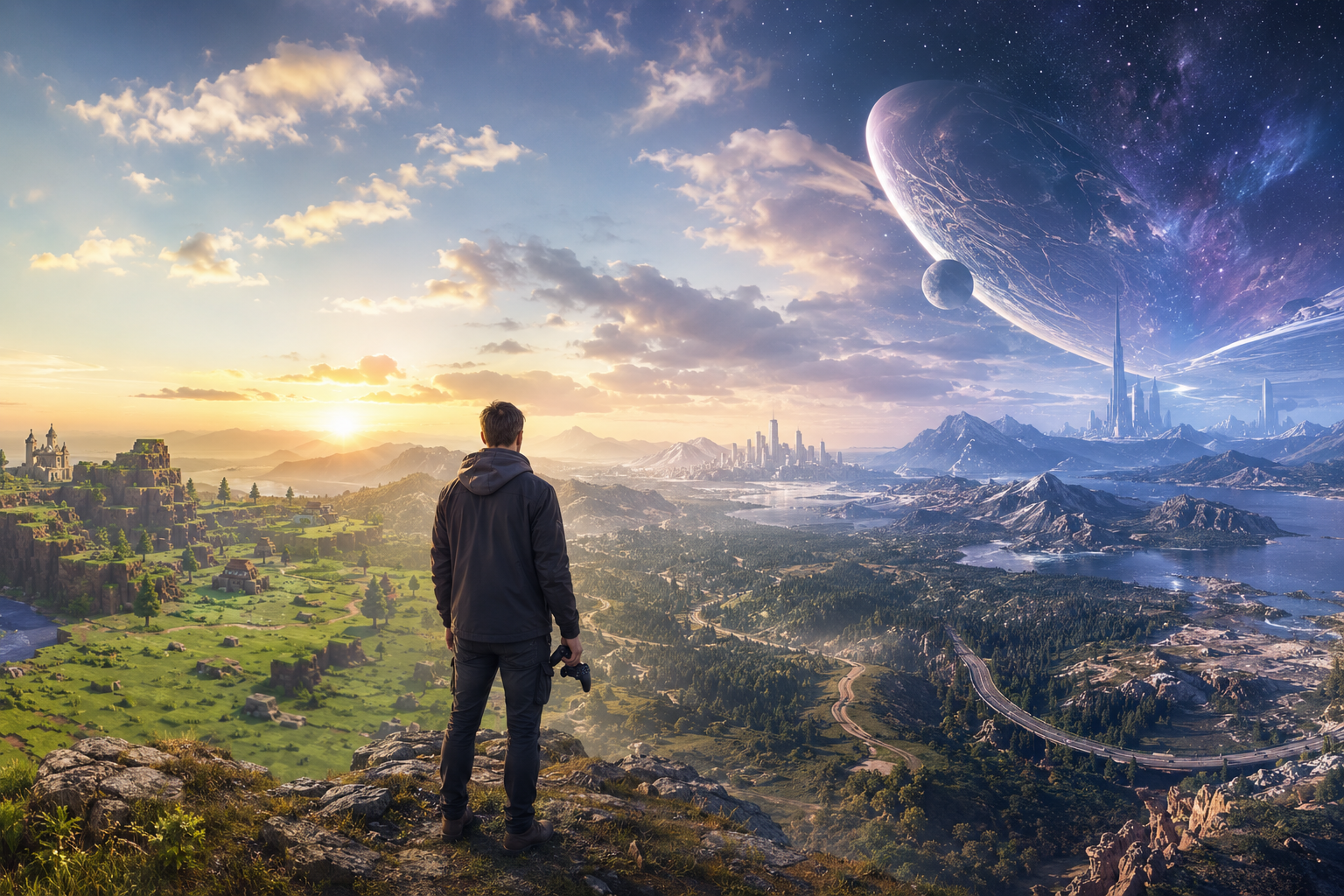
Open-world games have transformed dramatically over the past four decades. What began as a collection of simple interconnected locations has evolved into living digital universes where players can explore cities, build settlements, influence economies, and create personal stories.
The journey was not driven by larger maps alone. Developers gradually introduced nonlinear objectives, environmental storytelling, dynamic characters, procedural generation, and increasingly sophisticated simulation systems.
Today, freedom has become one of gaming’s most compelling promises. Understanding the evolution of the genre reveals how technical limitations, creative experimentation, and player expectations shaped the virtual worlds we now take for granted.
Before Open Worlds: The Era of Linear Progression
Early video games were usually built around straightforward progression. Players moved through levels in a fixed order, defeated enemies, reached an exit, and continued to the next stage.
This approach was partly a creative choice, but it was also dictated by hardware. Limited memory made it difficult to store expansive environments, numerous characters, or persistent changes to the game world.
Arcade games especially needed to deliver immediate action. Their designs favored short stages, escalating difficulty, and easily understood goals rather than free exploration.
Even so, some developers began looking for ways to let players choose where to go. Their experiments would eventually become foundational chapters in video game history.
Early RPGs Introduced the Idea of Player Freedom
Role-playing games were among the first genres to challenge completely linear design. Inspired by tabletop adventures, early RPGs allowed players to travel between locations, manage resources, and decide which challenges to pursue.
Text-based adventures also played an important role. Without detailed graphics, these games relied on descriptions to create the illusion of enormous worlds. Players typed commands, investigated rooms, collected objects, and solved problems in different ways.
Ultima and the Digital Overworld
The Ultima series helped establish the overworld map as an essential RPG feature. Instead of moving through isolated levels, players could cross wilderness areas, visit settlements, enter dungeons, and speak with inhabitants.
These environments were modest by modern standards, but they created a powerful feeling: the world existed beyond the immediate objective.
Ultima encouraged discovery and experimentation. It suggested that a game world could be more than a backdrop—it could become the central attraction.
Elite Looked Toward the Stars
Released in 1984, Elite presented an even more ambitious vision. Its space-trading structure let players travel between star systems, trade commodities, fight enemies, and improve their spacecraft.
Elite used procedural techniques to create the impression of a universe far larger than conventional handcrafted environments. Its systems gave players a degree of independence that was remarkable for the period.
The game demonstrated that meaningful space exploration gameplay did not require every location to be manually constructed. Rules and algorithms could generate scale while leaving room for personal adventure.
The 1980s and 1990s Expanded Environmental Freedom
As computers and consoles became more powerful, developers could create bigger maps with more recognizable geography. Exploration gradually moved from abstract grids toward visually coherent landscapes.
Games such as The Legend of Zelda gave players an interconnected overworld filled with secrets, tools, and optional discoveries. Although progression still depended on acquiring specific items, the experience felt considerably less restrictive than traditional stage-based adventures.
The original Zelda also rewarded curiosity. Suspicious walls, hidden caves, and seemingly empty areas could contain valuable surprises. This philosophy helped make adventure game exploration an integral part of the player experience.
Midwinter Combined Exploration and Simulation
Midwinter, released in 1989, placed players in a large snowy environment that could be crossed using different forms of transportation. Its combination of strategic planning, first-person action, and geographic freedom was unusually advanced.
Rather than simply offering a broad map, it connected the landscape to the game’s mechanics. Distance, terrain, and travel decisions affected the player’s strategy.
This distinction remains important. A successful open world is not merely spacious; its geography must influence how the game is played.
The Elder Scrolls Pursued Enormous Scale
The Elder Scrolls: Arena and Daggerfall pushed fantasy RPGs toward unprecedented scale during the 1990s. They offered towns, wilderness regions, dungeons, factions, quests, and character progression within enormous virtual territories.
Daggerfall became particularly famous for its massive procedurally generated world. Much of its content followed reusable patterns, but the sense of scale was astonishing for its time.
These titles established principles that would remain central to the open-world games evolution: unrestricted travel, optional quests, character customization, and the freedom to temporarily ignore the main story.
3D Graphics Changed the Meaning of Exploration
The transition from two-dimensional maps to fully navigable 3D environments was one of the genre’s most important turning points.
A world could now be understood through visible landmarks rather than icons on a map. Mountains, towers, roads, and distant buildings naturally guided players toward potential discoveries.
Games such as The Legend of Zelda: Ocarina of Time connected open areas with towns, dungeons, and story-driven locations. Its world was not seamless, but the ability to ride across Hyrule Field created a memorable sensation of scale.
Meanwhile, games like Body Harvest experimented with large environments, vehicles, and objectives that could be approached from different directions. These experiments helped prepare players for the urban sandboxes that followed.
Grand Theft Auto III Defined the Modern Urban Sandbox
Grand Theft Auto III, released in 2001, changed how mainstream audiences understood open-world design. Liberty City was not simply a large map connecting missions. It felt like a functioning urban playground.
Players could follow the story, steal vehicles, search for collectibles, cause chaos, or drive through the city without pursuing a formal objective.
Pedestrians, traffic, radio stations, police responses, and changing weather made the environment feel active. These systems reacted to the player and created unexpected situations between scripted missions.
Freedom Became Part of the Entertainment
One of the game’s greatest achievements was making unscripted activity entertaining. Driving across the city could lead to a police chase, a spectacular collision, or the discovery of a hidden area.
This emergent structure became essential to sandbox game design. Developers no longer needed to control every second of the experience. They could build interconnected systems and allow surprising events to emerge naturally.
Later Grand Theft Auto games expanded this formula with larger cities, more detailed characters, additional activities, and stronger environmental storytelling.
Open-World RPGs Became Living Fantasy Worlds
While urban sandboxes emphasized action and experimentation, RPG developers focused on identity, choice, and immersion.
The Elder Scrolls III: Morrowind presented a strange landscape that rarely held the player’s hand. Directions were often delivered through dialogue, encouraging players to study the environment and navigate through observation.
Oblivion and Skyrim made the structure more accessible. Fast travel, visible quest markers, dynamic encounters, and highly recognizable landmarks helped a wider audience engage with enormous fantasy worlds.
Exploration Became Its Own Reward
In many open-world RPGs, players begin walking toward a quest objective but become distracted by a cave, ruin, village, or unusual character.
This cycle is deliberate. Effective worlds repeatedly place points of interest within sight, encouraging curiosity without forcing a particular route.
Exploration also supports environmental storytelling. An abandoned cabin, scattered belongings, or damaged machinery can communicate an entire tragedy without a cinematic sequence.
This subtle approach strengthened open-world RPG experiences by letting players discover stories at their own pace.
The Seventh Console Generation Popularized the Formula
During the Xbox 360 and PlayStation 3 era, open-world design became one of the industry’s dominant formats.
Assassin’s Creed introduced historical cities designed around climbing, rooftop movement, and social stealth. Its architecture was not merely decorative; it determined how players navigated and approached objectives.
Far Cry shifted the formula toward hostile wilderness. Players could scout outposts, choose weapons, release animals, start fires, or attack from different angles. Its environments functioned as tactical spaces instead of simple travel corridors.
Red Dead Redemption used open landscapes to produce a different emotional effect. Long journeys across the frontier created solitude, anticipation, and a strong sense of place.
These games proved that gaming exploration could serve multiple genres, including stealth, shooters, western adventures, survival games, and action RPGs.
Minecraft Turned the World Into a Creative Platform
Minecraft represented another major evolutionary leap. Rather than filling a static map with developer-authored missions, it gave players a procedurally generated environment that could be dismantled and rebuilt.
Every block became both terrain and a potential resource. Mountains could be excavated, forests could supply settlements, and empty plains could become elaborate cities.
Players Became World Builders
Minecraft blurred the boundary between exploration and creation. Discovering a landscape was only the beginning; players could permanently transform it.
Its survival mechanics generated natural goals such as finding food, constructing shelter, exploring caves, and preparing for dangerous enemies. Creative mode removed those pressures and turned the game into a limitless digital construction set.
The result was an open world that supported survival, architecture, education, multiplayer communities, and player-created challenges within the same basic framework.
Narrative Design Adapted to Player Choice
Expansive worlds created a difficult storytelling problem. Traditional narratives rely on carefully controlled pacing, while open-world players may abandon the central plot for hours.
Developers responded by dividing stories into different layers. A main campaign provides structure, side quests deepen characters, and environmental details reward independent discovery.
The Witcher 3 demonstrated how optional quests could deliver stories as emotionally complex as the primary narrative. Even apparently minor assignments could involve difficult decisions and unexpected consequences.
Red Dead Redemption 2 further developed this approach through camp conversations, chance encounters, daily routines, and subtle character reactions. Its world felt convincing because narrative details existed outside formal missions.
Dynamic Systems Made Worlds Feel Alive
Modern open-world games increasingly depend on interconnected simulations.
Weather can affect visibility and movement. Wildlife may hunt other animals. Factions can fight over territory. Characters may follow schedules, react to crimes, or remember earlier player decisions.
These systems create emergent moments that cannot always be predicted by designers. A routine journey might become memorable because a storm arrives, enemies attack, and nearby wildlife disrupts the battle.
However, complexity must support meaningful gameplay. A world filled with systems can still feel artificial if player actions have no lasting consequences.
The best modern sandboxes balance simulation with carefully authored content, ensuring that freedom does not come at the cost of personality.
Procedural Generation Created Near-Infinite Universes
Procedural generation moved beyond the dungeons and star maps of early games to become a defining feature of modern large-scale worlds.
No Man’s Sky used algorithms to construct an enormous universe of planets, ecosystems, terrain formations, and resources. Its scale fundamentally changed the meaning of distance in a video game.
Instead of asking whether players could reach the edge of the map, it asked how they would choose a destination in a universe containing more locations than any individual could realistically visit.
Games with procedural environments gain extraordinary scale, but they also face a challenge: generated content can become repetitive. Variation alone does not guarantee significance.
Developers therefore combine procedural systems with handcrafted stories, unique locations, progression mechanics, and community-driven goals.
Modern Open Worlds Emphasize Density Over Size
For years, marketing campaigns frequently promoted map size as evidence of ambition. Eventually, players began questioning whether larger worlds were necessarily better.
An enormous environment can feel empty when activities are repetitive or widely separated. A smaller location may feel more satisfying when every district contains distinctive characters, mechanics, and visual details.
Modern design increasingly favors density, verticality, and interaction. Cities contain accessible interiors, rooftops offer alternative routes, and environmental objects respond to player actions.
This shift reflects a more mature understanding of massive sandbox games. Scale remains impressive, but meaningful discovery is more valuable than raw geographic size.
The Future: From Open Maps to Persistent Universes
The next generation of open worlds will likely become more reactive, persistent, and personalized.
Improved artificial intelligence could allow non-player characters to respond more naturally to changing conditions. Instead of repeating fixed routines, inhabitants may develop relationships, remember conflicts, and adapt to player behavior.
Procedural technology may also produce more sophisticated missions, cultures, ecosystems, and settlements. The central challenge will be maintaining consistency and narrative quality while expanding variation.
Cloud infrastructure could support worlds shared by thousands of players, while virtual reality may make exploration feel more physical and immediate. User-generated content will continue extending games long after their original release.
Yet technology alone will not determine the genre’s future. Players still need compelling reasons to travel, experiment, and care about what they discover.
Open Worlds Changed How Players Experience Games
The history of open-world design is ultimately a history of expanding player agency.
Early RPGs introduced connected maps and optional destinations. Space simulations imagined algorithmic universes. Three-dimensional sandboxes transformed movement, while modern RPGs combined exploration with choice and emotional storytelling.
Minecraft made world modification central to play, and procedurally generated games pushed virtual scale toward the practically infinite.
The most important achievement is not the size of these environments. It is their ability to create personal memories. Two players can enter the same world, follow different paths, and leave with completely different stories.
From primitive overworld maps to persistent digital universes, open-world games have turned exploration into a form of authorship. The player is no longer merely progressing through a designed sequence—they are helping determine what the adventure becomes.