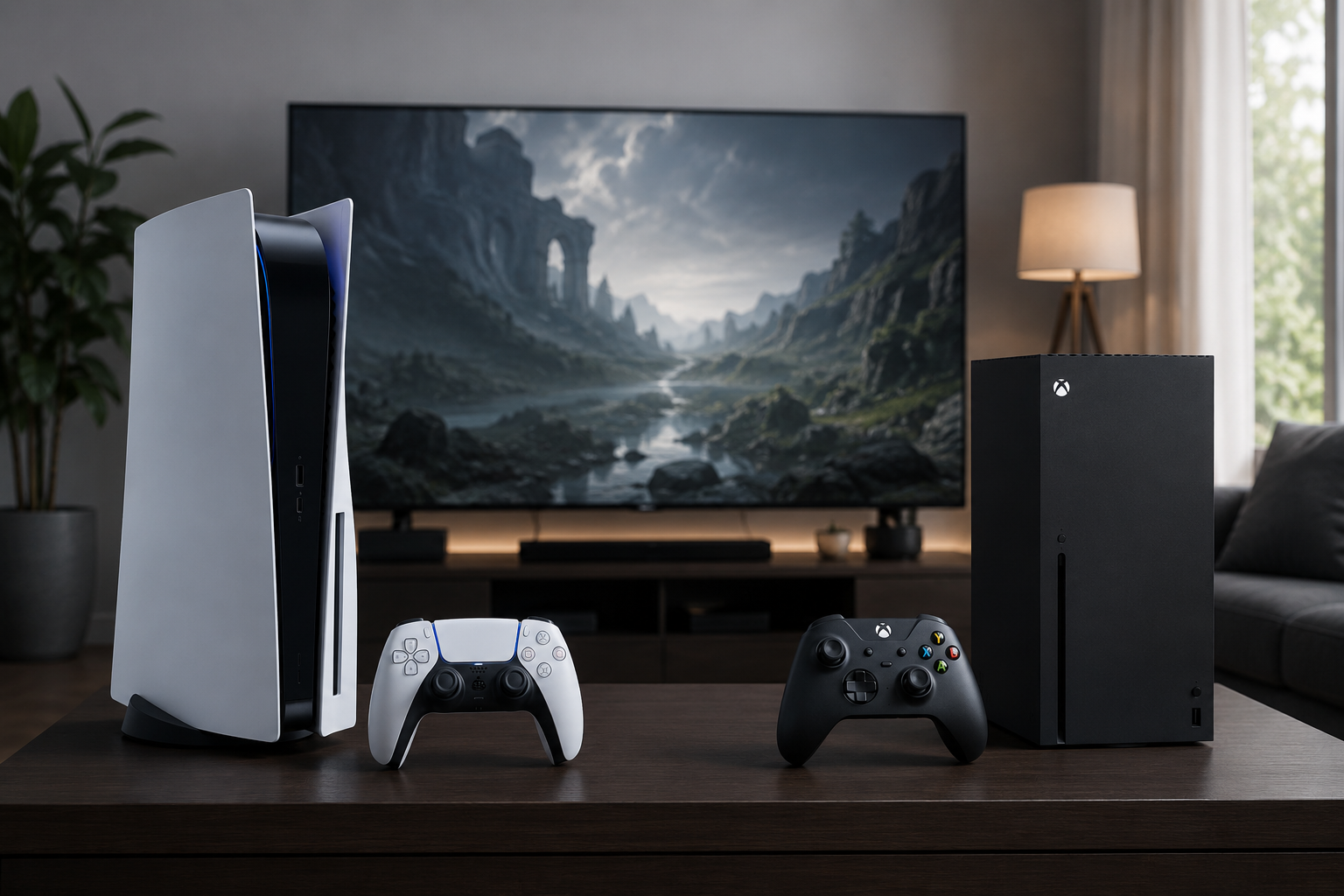
PS5 vs Xbox Series X remains one of the most important comparisons for anyone planning to buy a current-generation console. Both systems deliver fast loading, sharp 4K visuals, high frame rates, and access to major multiplatform releases, but they approach gaming from noticeably different directions.
PS5 focuses on immersive controller technology and a strong collection of cinematic first-party games. Xbox Series X emphasizes raw graphics performance, backward compatibility, cloud integration, and the value offered by Game Pass.
So, which console deserves your money? This objective comparison examines hardware, storage, controllers, exclusive games, subscriptions, and long-term value.
PS5 vs Xbox Series X Hardware Specifications
On paper, Xbox Series X has the advantage in raw graphics power. Its custom AMD RDNA 2 GPU delivers approximately 12.15 teraflops from 52 compute units, while the standard PS5 produces around 10.28 teraflops from 36 compute units.
Both consoles use eight-core AMD Zen 2 processors. Xbox Series X can reach up to 3.8 GHz without simultaneous multithreading, while the PS5 processor operates at a variable frequency of up to 3.5 GHz.
These numbers suggest that Xbox Series X should consistently outperform PS5. In real gameplay, however, the difference is usually less dramatic.
Developers optimize games individually for each platform. Some titles maintain a slightly higher resolution on Xbox Series X, while others run almost identically or occasionally perform better on PS5 after optimization updates.
Both systems are built to deliver 4K gaming and can support frame rates of up to 120 fps in compatible games. Achieving native 4K at 120 fps remains demanding, so many titles use dynamic resolution, temporal reconstruction, or separate quality and performance modes.
For most players, the practical conclusion is simple: Xbox Series X is technically more powerful, but both consoles provide an excellent current-generation gaming experience. Readers following the latest console technology should look beyond teraflop figures and consider how individual games actually perform.
Graphics Quality and Real-World Performance
The visual differences between PS5 and Xbox Series X are often difficult to notice without placing both versions side by side. Major releases generally feature comparable textures, lighting, shadows, and environmental detail.
Quality mode commonly prioritizes a higher resolution, advanced ray tracing, and richer visual effects at around 30 fps. Performance mode usually lowers resolution or selected graphical settings to target 60 fps.
Some competitive games also include a 120 Hz mode for compatible televisions or monitors. This option provides smoother motion and lower perceived input latency, although image quality may be reduced.
Variable Refresh Rate support helps both consoles minimize screen tearing when performance fluctuates. Auto Low Latency Mode can also instruct a compatible television to switch into its fastest gaming preset.
Xbox Series X holds a modest technical advantage when developers fully use its larger GPU. PS5 remains highly competitive because performance depends on more than theoretical power. Engine design, memory management, resolution scaling, and platform-specific optimization can all affect the final result.
Therefore, buyers should not select a console based entirely on minor pixel-count differences. The available games and overall ecosystem will have a much greater impact on everyday enjoyment.
SSD Speed, Loading Times, and Storage Expansion
PS5 has an exceptionally fast custom SSD architecture. The original model includes an 825 GB internal SSD, while newer revisions may offer different storage capacities depending on the edition and market.
Its raw internal bandwidth reaches approximately 5.5 GB per second. This allows supported games to load environments rapidly and reduce interruptions caused by traditional loading screens.
Xbox Series X generally includes a 1 TB custom NVMe SSD, although Microsoft has released additional configurations with different capacities and disc-drive options. Its internal drive offers lower raw bandwidth than PS5, but Microsoft’s Velocity Architecture combines storage, decompression, and software features to accelerate asset delivery.
In ordinary use, both consoles feel extremely responsive. PS5 may load certain optimized games faster, while the result can be nearly identical in other releases.
Storage expansion is where the two systems take different approaches. PS5 accepts compatible M.2 NVMe SSDs that meet Sony’s speed and size requirements. This gives owners a broader selection of brands and capacities.
Xbox Series X uses proprietary expansion cards designed to match the performance of its internal SSD. Installation is very easy, but compatible cards can be more expensive than standard M.2 alternatives.
External USB drives can store games on both platforms. However, most native current-generation games must be transferred to supported high-speed storage before they can be played.
Anyone building a large current-generation game library should include storage expansion costs in the purchasing decision, especially because modern AAA games can consume well over 100 GB each.
Design, Cooling, and Connectivity
PS5 has a tall, curved design that immediately stands out in an entertainment setup. Newer slim revisions are smaller than the launch model, although they still occupy considerable space.
Xbox Series X uses a simpler rectangular tower design. Its compact footprint makes it easier to position vertically, but the console can also be placed horizontally if the ventilation openings remain unobstructed.
Both machines use large cooling systems and are generally quiet under normal conditions. Fan noise can vary depending on room temperature, dust buildup, console placement, and the intensity of the game being played.
Adequate airflow is essential. Neither console should be pushed into a tightly enclosed cabinet, placed directly against a wall, or surrounded by objects that block its air intake and exhaust.
Both platforms support HDMI 2.1 features on compatible displays, including 4K output at high refresh rates. Actual feature availability can depend on the television, HDMI port, cable, and individual game.
Xbox Series X includes broader support for technologies such as Dolby Vision gaming in compatible content. PS5 counters with its own 3D audio implementation and display features developed around the PlayStation ecosystem.
DualSense vs Xbox Wireless Controller
The DualSense controller is one of the strongest reasons to choose PS5. Its adaptive triggers can change resistance according to actions such as pulling a bow, accelerating a vehicle, or firing different weapons.
Advanced haptic feedback produces more detailed sensations than conventional vibration. Developers can simulate environmental textures, weapon impacts, weather effects, and movement across different surfaces.
These features can make supported games feel more immersive. Their effectiveness depends on implementation, and some third-party titles use them more extensively than others.
The Xbox Wireless Controller follows a more traditional design. It is comfortable, familiar, and particularly well suited to long gaming sessions. Its asymmetrical analog-stick layout remains popular among racing, shooting, and action-game players.
Xbox controllers commonly use AA batteries by default, although rechargeable battery packs are available separately. DualSense includes an internal rechargeable battery but normally requires more frequent charging because of its advanced features.
Players interested in game controller comparisons should consider ergonomics as seriously as technology. DualSense offers more ambitious feedback, while the Xbox controller provides excellent simplicity, durability, and broad compatibility with PCs and mobile devices.
PlayStation Exclusive Games
PlayStation traditionally has a stronger reputation for polished, story-driven action games. The PS5 catalogue includes major titles and franchises such as Astro Bot, Demon’s Souls, Marvel’s Spider-Man, Gran Turismo, Ratchet & Clank, The Last of Us, God of War, Horizon, Returnal, and Ghost of Yōtei.
Upcoming or recently promoted PlayStation releases can further strengthen the platform, with projects such as Marvel’s Wolverine attracting considerable attention.
However, “exclusive” now requires a more careful definition. Several PlayStation Studios games eventually arrive on PC, and some releases are also available on PS4. They may remain console-exclusive to PlayStation without being permanently restricted to PS5.
For players who prioritize cinematic single-player adventures, character-focused storytelling, and Japanese-developed games, PS5 remains particularly attractive.
The PlayStation brand also tends to receive strong support from major Japanese publishers. Most important third-party games launch on both consoles, but certain smaller Japanese titles may appear on PlayStation while skipping Xbox.
Fans searching for the best PS5 games will find an established catalogue covering action, racing, role-playing, platforming, horror, and family-friendly experiences.
Xbox Games and the Changing Meaning of Exclusivity
Xbox Series X offers access to franchises such as Halo, Forza, Gears, Microsoft Flight Simulator, Age of Empires, and titles produced by studios under Xbox Game Studios, Bethesda, and Activision Blizzard.
Microsoft’s publishing strategy has changed substantially, however. More Xbox-owned games are now appearing on competing platforms, including PlayStation. This means buying Xbox Series X purely for permanent console exclusives is less convincing than it was earlier in the generation.
That does not make the console irrelevant. Its real strength is convenient access to the wider Xbox ecosystem.
Games can often be played across Xbox consoles, Windows PCs, and supported cloud devices. Cross-save features allow users to continue their progress on another compatible platform, while Xbox Play Anywhere supports selected digital purchases across console and PC.
Xbox Series X is therefore best viewed as a powerful gateway into Microsoft’s gaming services rather than a closed box built entirely around exclusives.
Players who already own a capable gaming PC may find less exclusive value in buying an Xbox. Those who want a straightforward living-room console with access to Microsoft’s catalogue may still consider it an excellent choice.
Game Pass vs PlayStation Plus
Game Pass remains one of Xbox Series X’s biggest advantages. Depending on the selected membership tier and regional availability, subscribers receive access to a rotating catalogue of console games, online multiplayer benefits, and selected first-party releases.
It is especially valuable for players who enjoy experimenting with different genres. Instead of purchasing every title separately, subscribers can download multiple games and move between them with less financial risk.
The weakness of any subscription catalogue is that availability can change. Third-party games may leave the service, and access ends when the subscription expires unless the player purchases the title.
PlayStation Plus also uses a tiered model. Higher tiers provide downloadable PS4 and PS5 catalogues, classic titles in supported regions, trials, cloud-related features, and other benefits.
PlayStation Plus offers substantial value, particularly for players who want to explore older PlayStation releases. Game Pass generally remains more closely associated with day-one access and integration across console and PC, although specific inclusions and membership benefits can change.
For players evaluating gaming subscription services, the best option depends on ownership habits. Subscriptions reward variety, while buying games individually provides more control over long-term access.
Backward Compatibility and Older Game Libraries
Xbox Series X has the broader backward-compatibility story. It supports a large selection of Xbox One games and compatible titles from earlier Xbox generations.
Features such as Auto HDR, FPS Boost, and higher-resolution rendering can improve selected older games without requiring developers to create full remasters. Not every title receives every enhancement, but the system is highly appealing to anyone with an established Xbox library.
PS5 supports the overwhelming majority of PS4 games. Many benefit from faster loading, steadier performance, or official current-generation updates.
Its compatibility with PS3, PS2, and original PlayStation software is more limited and often depends on remastered releases, digital catalogue availability, or streaming services in supported regions.
Xbox Series X is the more flexible option for preserving several generations of compatible console purchases. PS5 is excellent for continuing a PS4 collection but offers a less comprehensive route to much older games.
Disc Editions and Digital Ownership
PS5 and Xbox Series X are sold in different configurations, so buyers should verify the exact model before purchasing.
A disc drive allows players to buy physical releases, borrow games, shop in the second-hand market, and resell completed titles. It can create meaningful long-term savings even if the initial console price is higher.
Digital editions are cleaner and may cost less upfront, but they lock purchases to the platform’s online store. Players cannot use second-hand discs or compare physical prices between retailers.
Some newer PS5 models support an attachable disc drive, while compatibility depends on the specific console revision. Xbox Series X is available in configurations with and without an optical drive, depending on the region.
Collectors and budget-conscious buyers should carefully consider physical media. Following practical console buying tips can prevent choosing a cheaper digital model that becomes more expensive over several years of game purchases.
Which Console Is Better for Multiplayer?
Most major competitive games support both PS5 and Xbox Series X. Cross-platform play has also reduced the importance of owning the same console as every friend.
Nevertheless, checking a regular gaming group remains essential. Cross-play is not universal, and some games restrict communication, ranked modes, progression, or competitive matchmaking between platforms.
PS5 benefits from a large global player base and strong support for popular sports, fighting, action, and multiplayer games. Xbox provides close integration with Microsoft accounts, PC gaming, and Game Pass.
Both consoles require a paid membership for online multiplayer in most premium games. Free-to-play titles generally allow online access without the same subscription requirement, although policies can vary.
Xbox may be more convenient for players whose friends divide their time between console and Windows PC. PS5 may be preferable if most friends already use PlayStation and share games or party features within that ecosystem.
PS5 vs Xbox Series X: Which One Is More Worth It?
PS5 is more worth buying for players who prioritize immersive controller features, strong cinematic games, Japanese publisher support, and the established PlayStation catalogue. It is also an appealing upgrade for anyone who already owns many PS4 titles.
Xbox Series X is more worth buying for players who want stronger theoretical GPU performance, excellent backward compatibility, flexible integration with Windows, and broad access to games through Game Pass.
For a player who already owns a capable PC, PS5 usually adds more distinct gaming experiences. Many Microsoft games are available on Windows, while several PlayStation releases still reach PC later than their console debuts.
For someone without a gaming PC who wants maximum variety from one subscription, Xbox Series X can deliver exceptional value. It is a powerful, quiet, and highly practical console even as Microsoft releases more games on other platforms.
There is no universal winner in the PS5 vs Xbox Series X comparison. Xbox Series X wins on raw GPU specifications, backward compatibility, and ecosystem flexibility. PS5 wins on controller innovation and a more distinctive console-focused game catalogue.
The smartest choice is the console that supports the games you genuinely want to play, fits your preferred ownership model, and connects you with the friends you play with most often.