
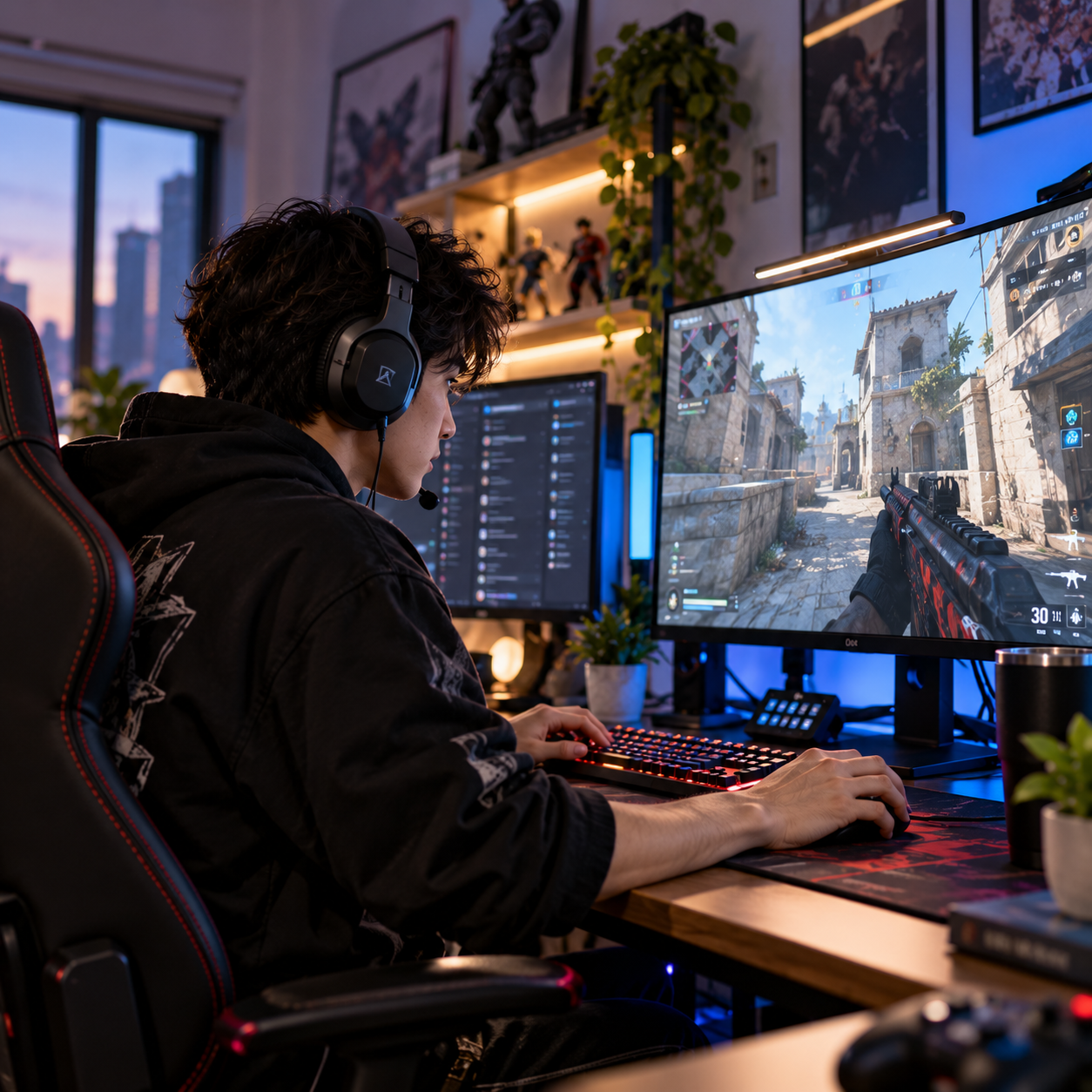
Getting better at games is often associated with spending more hours in front of the screen. While experience certainly matters, playing longer does not automatically produce better results. Repeating the same mistakes for several hours can reinforce bad habits rather than improve performance.
Effective gaming skill improvement comes from practicing with a purpose. Understanding game mechanics, developing consistency, reviewing mistakes, and focusing on specific weaknesses can produce more progress than simply playing match after match.
Whether you enjoy competitive shooters, MOBAs, fighting games, racing titles, or strategy games, a more structured approach can make practice both more productive and enjoyable.
Learn the Core Mechanics First
Every game has fundamental mechanics that influence everything else.
In shooters, these may include aiming, movement, positioning, recoil control, and weapon behavior. Fighting games require an understanding of movement, spacing, blocking, timing, and combinations. Strategy games may depend more heavily on resource management, map awareness, and decision-making.
Players sometimes rush toward advanced techniques before mastering these fundamentals.
That can create inconsistent performance.
Instead, identify the mechanics that appear repeatedly during normal gameplay and become comfortable with them first. Strong fundamentals provide a foundation that makes advanced strategies easier to understand later.
Stop Changing Your Settings Constantly
Finding comfortable settings is important, but continuously adjusting them can make improvement more difficult.
This is especially noticeable in competitive shooters.
Changing mouse sensitivity every few matches forces your hand and muscle coordination to repeatedly adapt. Similar problems can happen when players constantly modify controller sensitivity, key bindings, camera settings, or field of view.
Experiment until you find settings that feel reasonable, then give yourself enough time to become familiar with them.
Consistency makes it easier to determine whether improvement is coming from actual practice rather than temporary changes to your setup.
Practice One Weakness at a Time
Trying to improve everything simultaneously can make practice unfocused.
Instead, choose one specific weakness.
Perhaps you frequently lose close-range fights. Maybe your positioning is poor, you forget to watch the minimap, or you make rushed decisions when under pressure.
Focus several sessions on that particular issue.
This approach creates a clear objective beyond simply winning.
Even if a match ends in defeat, the session can still be productive if you improved the skill you were specifically practicing.
Structured gaming practice turns individual matches into learning opportunities rather than treating the final score as the only measure of progress.
Review Why You Lost
Losing can provide useful information when you examine what happened.
Instead of immediately blaming teammates, matchmaking, equipment, or luck, identify the decisions you personally controlled.
Ask simple questions.
Was your positioning unnecessarily risky? Did you engage without enough information? Did you miss an important sound cue? Did you use an ability too early? Were you concentrating on the wrong area?
Not every loss is caused by an individual mistake, especially in team-based games. However, focusing on factors within your control gives you something practical to improve.
Record Gameplay When Possible
Watching your own gameplay can reveal mistakes that are difficult to notice while actively playing.
During a match, attention is divided between movement, opponents, teammates, objectives, sound, and many other signals.
When reviewing a recording, you can pause and examine decisions more carefully.
Look for repeated patterns rather than isolated errors.
If you repeatedly enter fights from poor positions or ignore the same type of information, you have identified a specific habit worth correcting.
Improve Game Sense, Not Just Mechanical Skill
Fast reactions and accurate inputs are valuable, but they are only part of competitive gaming skills.
Game sense refers broadly to understanding what is happening and anticipating what may happen next.
It can include predicting enemy positions, recognizing patterns, understanding objectives, managing resources, knowing when to attack or retreat, and adapting to the behavior of other players.
Game sense develops through experience, but experience becomes more valuable when combined with observation.
Pay attention to why strong players make particular decisions instead of simply copying what they do.
Understanding the reasoning behind a strategy makes it easier to apply that knowledge in different situations.
Learn Maps Thoroughly
Map knowledge can provide a significant advantage in many multiplayer games.
Knowing important routes, cover positions, objective locations, sightlines, shortcuts, spawn areas, and common engagement points reduces the number of decisions you need to make under pressure.
Explore maps outside high-pressure matches when the game allows it.
Rather than memorizing everything immediately, begin with locations that appear most frequently during normal gameplay.
As familiarity grows, you can start learning more advanced positioning and movement options.
Good map knowledge allows you to spend less time figuring out where to go and more time thinking about what opponents are likely to do.
Use Training Modes Efficiently
Many games provide practice ranges, tutorials, custom matches, training modes, or other tools designed for skill development.
Use them with a specific purpose.
For example, spending ten focused minutes practicing accuracy can be more productive than randomly shooting targets for an hour.
Fighting game players can practice a particular defensive response. Racing players can repeatedly work on one difficult corner. Strategy players can practice an opening sequence until the actions become comfortable.
Short, focused exercises make gaming skill improvement easier to measure.
Watch Better Players With a Purpose
Watching skilled players can be educational, but passive viewing has limitations.
Do not focus only on impressive mechanical plays.
Observe positioning, timing, resource management, movement, communication, and decision-making.
Ask why the player chose one option instead of another.
When possible, watch someone using the same character, role, weapon, vehicle, or strategy you are trying to improve.
This makes it easier to compare their decisions with your own gameplay.
Avoid copying strategies without understanding the context. A technique that works for an experienced player may depend on mechanical ability, team coordination, or game knowledge that needs to be developed separately.
Communication Matters in Team Games
Mechanical ability alone cannot solve every situation in multiplayer games.
Clear communication helps teams share information and coordinate decisions.
Useful communication is usually concise.
Enemy locations, objective status, available resources, or immediate plans are more valuable than constant commentary.
Emotional arguments rarely improve team performance.
If a match becomes frustrating, maintaining clear communication and focusing on the next decision is generally more useful than discussing previous mistakes while the game is still happening.
Take Breaks Before Performance Collapses
Long gaming sessions can gradually reduce concentration.
Reaction speed, patience, decision-making, and awareness may become less consistent when fatigue increases.
The problem is that players do not always notice the decline immediately.
If you begin making unusually simple mistakes or repeatedly playing on autopilot, a short break may be more useful than another match.
Rest is part of effective gaming practice.
Returning with better concentration can provide more productive practice than continuing through frustration simply to accumulate additional hours.
Keep Your Hardware Consistent
Expensive equipment does not automatically make someone a better player.
However, a stable setup can support consistent practice.
Sudden frame-rate drops, unreliable connections, uncomfortable controls, or poorly configured displays can interfere with gameplay.
Aim for stable performance rather than obsessing over having the newest hardware.
A comfortable mouse or controller, consistent frame rate, suitable display settings, and reliable audio are generally more useful than frequently changing equipment in search of an instant improvement.
Track Progress Beyond Wins and Losses
Rank and win rate can be useful indicators, but they do not show every form of improvement.
You might be making better decisions even during a losing streak.
Track smaller indicators related to the skill you are developing.
For example, a shooter player might monitor accuracy or unnecessary deaths. A strategy player could focus on resource efficiency. A fighting game player might measure how consistently they punish specific mistakes.
These smaller improvements eventually influence overall performance.
They also provide motivation when ranking progress temporarily slows.
Keep Gaming Enjoyable
Improvement is satisfying, but games are still entertainment.
Turning every session into an intense performance test can eventually remove the enjoyment that made you interested in the game.
Balance focused practice with casual play.
Try different modes, play with friends, explore new characters, or occasionally ignore rankings altogether.
A sustainable approach makes it easier to continue developing over time without turning gaming into another exhausting obligation.
Conclusion
Effective gaming skill improvement is not determined solely by how many hours you play. Focused practice, strong fundamentals, gameplay review, map knowledge, communication, and consistent settings can make the time you already spend gaming much more productive.
Choose specific weaknesses instead of trying to improve everything at once. Analyze mistakes without obsessing over individual losses and take breaks when concentration begins to decline.
Playing smarter does not guarantee immediate results, but it creates a much stronger foundation for long-term improvement while keeping gaming enjoyable.